Through-Feed Drill-and-Cut Integrated Machines Explained: The No-Flip Route to Custom Panel Production
An industry knowledge article - how through-feed drilling-and-cutting integrated machines work, how they compare with six-side drilling centers and CNC nesting machines, and what to evaluate when buying one.
Meta description (suggested): Why do leading custom-furniture plants drill full sheets before cutting them into panels? How no-flip, dual-face through-feed machines compare with six-side drills and CNC nesting, and how the TT-H9A fits in.
Introduction: the two-machine dilemma in custom panel furniture
For years, panel furniture manufacturers faced a binary choice when automating drilling and cutting:
Route A - the six-side drilling center (六面钻): cut boards into panels first, then feed every panel through a drilling center that machines holes and grooves on all six faces. Precision is excellent, but the machine only earns its keep on standardized, repeatable panel sizes.
Route B - the CNC nesting machine (开料机): nest and cut parts directly from full sheets, with a vertical drill pack for basic holes. Extremely flexible with sizes and shapes, but panels usually have to be flipped for drilling on the second face, and most layouts need a second positioning step that costs accuracy and time.
Custom (made-to-measure) furniture exposes the weakness of both routes. Order panels are almost never standard-size: dimensions vary, boards come in countless surface finishes, and irregular shapes are routine. Six-side drilling centers digest engineering-standard batches efficiently but choke on high-mix non-standard orders; nesting machines handle irregular panels flexibly but struggle to reach the output and hole accuracy that a growing factory needs.
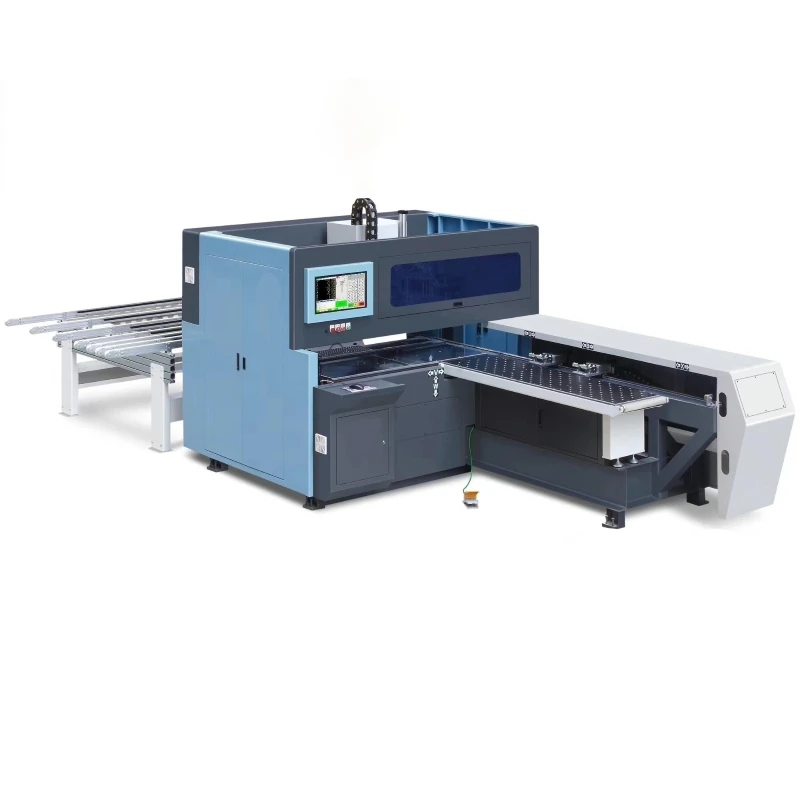
Out of this gap, a third category emerged - the through-feed drill-and-cut integrated machine (打孔开料一体机, also known in the industry as a 孔料一体机 or "integrated drilling & cutting" machine). It combines the two core ideas: drill the holes first, on the full sheet, on both faces, without flipping - then cut the sheet into finished, ready-for-edging panels.
1. What "through-feed, drill-before-cut" actually means
The name packs three process principles that define this machine class:
1) Drill first, cut second. Holes are machined while the workpiece is still a full, stable sheet - before it is separated into individual panels. This is the opposite order of a six-side-drill workflow, and it exists for a concrete physical reason: when a large board is cut into smaller panels, internal stresses are released and panels can deform slightly. Drilling after cutting therefore risks hole positions drifting relative to the design. Drilling on the full sheet first locks the hole pattern to the sheet coordinate system, while the panel geometry is still un-deformed.
2) No flipping (免翻板). Conventional nesting machines drill the top face, then the operator - or a separate turning device - flips the sheet to drill the underside. A through-feed drill-and-cut machine carries its own drill units for both faces, so top-face and bottom-face machining happen in the same setup. This removes the most labor-intensive and error-prone step in panel drilling.
3) One positioning, one pass. Because both faces are machined in a single clamping and the part is not repositioned for a second operation, dimensional consistency between the two faces is built into the process rather than dependent on re-clamping accuracy.
2. How the process flows in production
A typical workflow on this machine class runs like this:
Full sheet in. Standard-size raw boards are loaded (manually or with an auto-loader).
Dual-face drilling. Independent drill units machine the connecting holes, dowel holes, grooves and slots required for the order - on the top face and the bottom face, with the two faces machined synchronously under two independent control systems.
Cutting. The sheet is then nested and cut into individual panels, including irregular and special shapes, by the machine's routing/spindle unit.
Outfeed. Panels leave labeled and sorted, ready for the next station - typically edge banding, side-hole drilling (with a synchronized side-drilling machine where horizontal hardware holes are needed) and assembly.
From the operator's point of view, a sheet goes in once and comes out as a set of fully drilled, dimensionally accurate panels - no flipping, no second clamping, no manual hole marking.

3. Why it matters for custom furniture production
The design of this machine class targets the specific economics of non-standard, high-mix production:
Hole accuracy on unstable boards. Non-standard custom orders often use boards that warp or deform more readily after cutting. Drilling first keeps hole patterns true to the design even when the cut panels are no longer perfectly flat.
Labor reductio