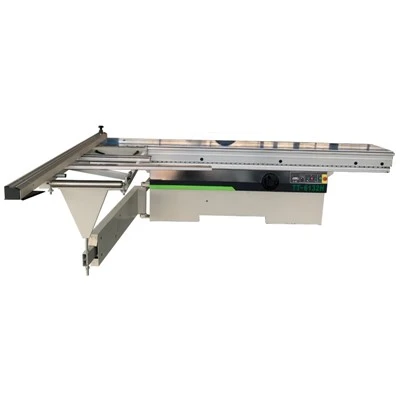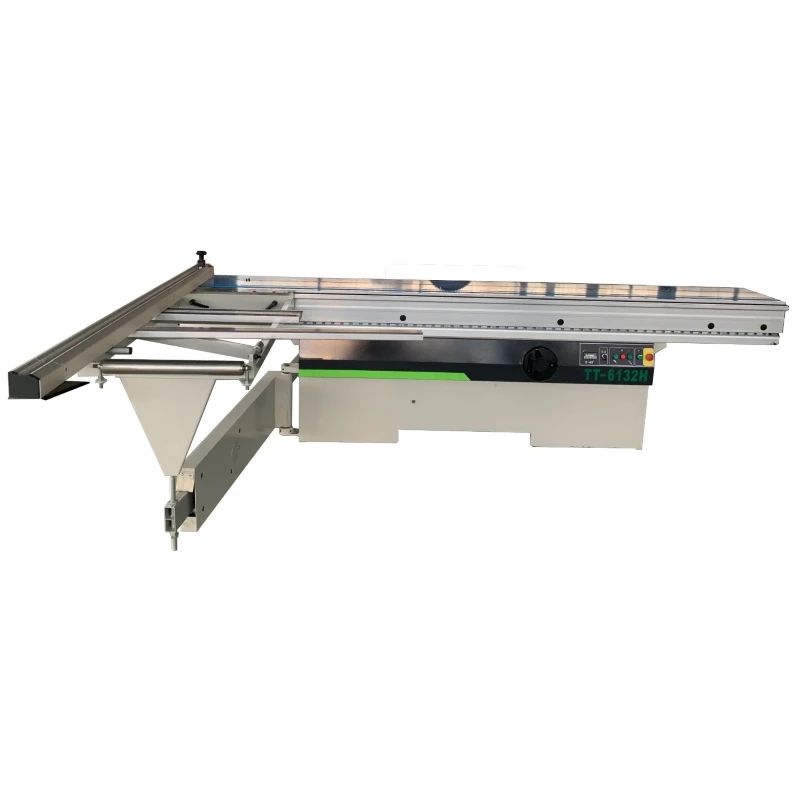
TingTing Woodworking Machinery Co., Ltd. is one of the leading manufacturers and suppliers of Automatic Panel Saw in China. As we have world-leading production equipment and strong manufacturing capabilities, we warmly welcome you to buy premium Automatic Panel Saw from our factory. For price consultation, contact us.
Most enquiries for a saw in this class start with a sheet size and a daily volume, and end with the question a catalogue cannot answer: will it still be square in three years, running eight hours a day, in a shop with one operator and nobody whose job title says maintenance?
The TT-6132H is what we quote when the answer has to be yes. It sits between a one-man workshop and a beam saw line: heavy enough that accuracy is a property of the iron rather than of the setup, simple enough that the only thing needing a service call is a worn part.
The figures that set it apart
Four numbers a buyer can verify on arrival
435
mm carriage width
950
kg net weight
6.6
kW
installed motors
12
h
shift rated

One operator, a 3,200 mm carriage and a 950 kg base. Weight here is not a specification to boast about: it is what stops the frame walking when a heavy sheet lands on the front of the table.
Where it fits, and where it does not
We sell this machine into three situations, and we talk the fourth one out of it.
- A cabinet shop with one or two people on the machine, working through several hundred boards a week in mixed sizes.
- A joinery that has outgrown a contractor saw but cannot justify a nesting centre, and still wants to cut by hand without the inaccuracy.
- A door shop where one bench handles 40 mm stiles and 18 mm carcass parts, so depth matters as much as length.
The situation we steer away from is a product line with three fixed sizes running for weeks. That work pays for a beam saw, because the labour saved per sheet is the whole cost model. Buy this instead and you will spend the savings on somebody's back.
A shift at the saw, first cut to last
The day starts with a check, not a cut. Rails wiped, table free of offcuts, blade seated, guard down. Two minutes, and it is the difference between a saw that holds tolerance and one that gets blamed for a bad batch two weeks later.
Then the setting up. Depth on the button until the display agrees with the job sheet. Angle checked against the readout if the run needs a bevel. Fence wound to the dimension, locked, and confirmed on the display rather than trusted to memory. A stop clamped on the crosscut fence for anything repeating.
Depth, angle, start and stop within reach of the hand that is not holding the panel. Putting the emergency stop here rather than at the cabinet is the sort of detail that only matters once.


Miter work indexes on a cast scale with flip stops, so a repeated length is set once and then cut.
From there the work is repetition: load, clamp, push, clear the offcut, stack, label. An automatic panel saw does not shorten that loop. What it shortens is everything around it, because the operator stops walking to a hand wheel and stops re-measuring a fence that moved.
Where the hours actually go
Ask three shops where a saw loses time and the answers are rarely about cutting speed. It is hunting for an offcut that was never labelled, re-marking a panel that was measured twice, and walking back to check a dimension that has already moved.
None of that is fixed by a faster spindle. It is fixed by a reference that does not shift and by stops that repeat, which is why the fence and the crosscut scale get more of our attention than the motor on this machine.
Batch by material rather than by job, too. Every blade change and scorer adjustment costs minutes; ten of them in a day is most of an hour that never shows up on a quote.
What the extra carriage width buys you
435 mm against 380 mm on the lighter TS-6132 is not a rounding difference. The extra width sits under the front of a board, which is the part that dips first and the part an operator's leading hand normally ends up carrying.
The extrusion behind that width: 398 mm across the top, 230 mm deep, 328.5 mm at the base. Depth is what resists twist, and the drawing is dimensioned so it can be checked with a caliper.

The four checks that keep it honest
Nobody needs a maintenance department for this machine, but four things decide whether year three behaves like year one:

HIWIN 25 profile rail with sealed blocks. Wiping it is the cheapest maintenance on the machine, and the one that decides how long it stays accurate.
Scorer in front, main blade behind, each on its own motor and depth. A chipped scorer still cuts, which is why it gets left in service too long.

- Wipe the rails and blow out the blocks. Board dust is abrasive, and a wiper only works while it is intact.
- Feel the carriage at both ends of its travel. A change in resistance is cheaper to investigate than a ruined batch.
- Check the fence for square against the blade, not against the scale. The scale tells you where the fence is, not whether the blade is straight.
- Inspect the scorer for chipped teeth. A damaged scorer still cuts, which is exactly why it gets left in service too long.
All four are visual or by hand. Nothing on this list needs a laptop, a licence or a service contract, which is the argument for buying automation at the tool rather than automation at the controller.
Safety, and the habits that outlast training
A machine that takes 120 mm of depth will not slow down for a hand. Three habits cover most of the risk, and none of them depend on the guard being fitted that morning.
- A push stick for anything closer than a hand's width to the blade, without exceptions and without discussion.
- The riving knife in the kerf before the first cut, not after the first pinch.
- The leading hand flat on the carriage, never in line with the teeth, whatever the panel length.

The guard covers the exposed arc and the knife follows in the kerf. Both are backstops: the habits above are what keep hands out of the zone in the first place.
Hearing protection and a mask are not optional on a saw running at 6,000 rpm in a room with a collector. Neither shows up in a quotation, and both show up in a workforce after ten years.
What arrives, and how it lands
The saw travels on a steel frame at 1,000 kg packed, blocked so nothing moves on its rails between the factory and your door. Lifting points are on the frame. Put a sling around the cabinet instead and the base casting pays for the shortcut.
Loaded by the frame, stacked square, lashed clear of the cabinet. A machine this heavy is damaged in transit by what it is tied to far more often than by what it is wrapped in.

On arrival it needs a level floor, a three-phase supply and a collector on the 100 mm outlet. Commissioning is included: the machine is assembled, aligned and run before it is packed, so the site work is positioning rather than rebuilding. Documentation covers the electrical drawings, the parts list and the CE paperwork.
The first week after delivery
Unload on the frame, not on the cabinet. Position the machine so a full sheet clears the wall on the loading side, then level it on the feet before anything is connected. A saw that is levelled after the first batch is a saw that has already cut its first batch out of square.
Electrical connection is a job for an electrician: isolator, cable sized for the motors, earth checked, direction of rotation confirmed before the blade goes on. Then a test cut on scrap, measured with a square and a tape, before any customer board goes near it.
The operator's first week sets the habits for the next five years. Give them a check sheet for the morning routine, let them run scrap until the fence and the stops feel natural, and keep the first production batch small enough that a mistake is a lesson rather than a claim.
Documents, terms and the handover
An export shipment of this size travels with a commercial invoice, a packing list, a bill of lading and a CE declaration. Ask for copies before the container is sealed, not after: correcting a document once the vessel has sailed is a week of emails and sometimes a demurrage charge.
Agree the delivery term in writing at the order stage, and agree who unloads at the destination. A tonne of machinery arriving without a forklift booked is a problem no amount of paperwork solves.
What to check on the first twenty panels
A saw either settles into a batch or starts drifting out of it. Twenty panels is enough to tell which, if somebody looks at four things:
- Diagonals on the first square cut. Equal means the fence is where it says it is.
- The underside edge on faced board. Chipping there is a scorer setting, not a blade problem.
- Burn marks along the cut. Feed rate and a dull tooth, in that order, before anything is adjusted.
- Dimension drift across the batch. A fence that creeps is a lock that needs attention, not a scale that needs re-reading.
Write the result on the job sheet rather than trusting memory. When a customer calls about a batch three weeks later, the sheet is the only record that the saw was checked at the start of it.
Spares worth keeping on the shelf
None of these are expensive, and each one is the difference between an hour of downtime and a week of waiting on freight:
- One main blade and one scorer, so a damaged edge does not stop the batch.
- A set of drive belts, because a belt is a consumable that announces itself as a vibration first.
- A contactor and a fuse kit matched to the cabinet, since both fail on a Monday morning.
- Wiper strips for the rail blocks, which are the cheapest part on the machine and the one that protects the most expensive alignment.
Dust is the other consumable. Size the collector for air volume, empty it before it fills, and check the duct once a season for a collapsed bend. A choked collector does not stop the saw; it just puts the fine dust back into the room.
Specification
| Model | TT-6132H |
| Max. cutting height 90 / 45 (mm) | 120 / 87 |
| Saw group tilting (degrees) | 45 - 90 |
| Main saw diameter (mm) | 250 - 300 x 30 bore |
| Scoring saw diameter (mm) | 120 |
| Scoring saw arbor (mm) | 20 |
| Scoring saw speed (rpm) | 8,000 |
| Main motor (kW) | 5.5 |
| Scoring motor (kW) | 1.1 |
| Sliding table (mm) | 3,200 x 435 |
| Weight net / packing (kg) | 950 / 1,000 |
| Voltage | 380 V, 50 Hz, 3P, optional |
Voltage is built to order; the standard build is 380 V, 50 Hz three phase. Paint, branding and configuration can be changed under our OEM and ODM programme, and the warranty runs a year with free replacement parts inside it, then parts and technical help for as long as the machine is in service.
Questions we get before the order
Voltage is built to order; the standard build is 380 V, 50 Hz three phase. Paint, branding and configuration can be changed under our OEM and ODM programme, and the warranty runs a year with free replacement parts inside it, then parts and technical help for as long as the machine is in service.
FAQ
Do I need a second person on the saw?
What does it cost to keep running?
Can it cut a countertop with a waterfall edge?
What if the site supply is not 380 V?
How is it moved once it is on the floor?
What does an operator need to know on day one?
Tell us the job sheet, not the brochure
Send the sheet sizes, the materials and how many hours a day the saw runs. We will tell you whether this automatic panel saw is the right purchase, and what it will cost you in labour if it is not.