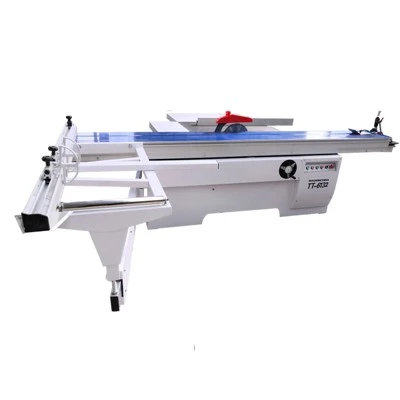
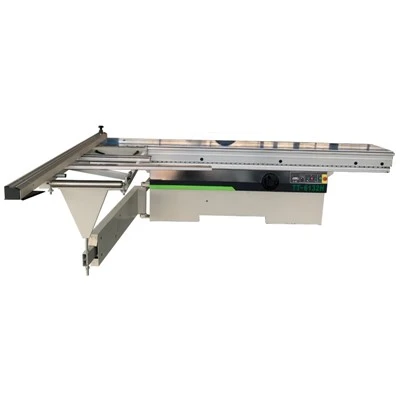
TingTing Woodworking Machinery Co., Ltd. is one of the leading manufacturers and suppliers of Wood Panel Cutting Machine in China. As we have world-leading production equipment and strong manufacturing capabilities, we warmly welcome you to buy premium Wood Panel Cutting Machine from our factory. For price consultation, contact us.
Products Description
A wood panel cutting machine is judged twice: on the first panel it cuts, and on the thousandth. The first cut proves the setup. The thousandth proves the table, the rail and the spindle behind it.
The TS-6132 is the heavy end of that argument. A 5.5 kW main motor, a 1.1 kW scoring blade and a 3,200 mm anodized sliding table on linear guides, built for shops that cut melamine and veneered board all day and cannot afford a chipped edge.
TS-6132 at a glance
Five numbers that separate it from a light table saw
5.5
kW main motor
3200
mm sliding table
120
mm cut at 90 degrees
8000
rpm scoring blade
What this wood panel cutting machine is built to do
The TS-6132 is a sliding table panel saw, the European layout: the panel rides on a carriage beside the blade rather than being pushed across a fixed table. That single change is why a full 2,440 x 1,220 mm sheet can be broken down by one operator without the sheet binding on the blade.
The carriage runs on precision linear guide rails and carries an anodized aluminium table 3,200 mm long and 380 mm wide. Anodising matters more than it sounds: bare aluminium picks up glue and scratches from panel edges, and a scored table drags for the rest of its life.

The carriage sits to the left of the blade line, so the operator controls the panel with both hands and never reaches across the cut. Two overhead guards ship with the machine, one for 90 degree cuts and one for 45 degree bevels, both on quick-change swing-away mounts.
The table is an extrusion, not a bolted assembly
Any sliding table can be shimmed flat on the day a machine is commissioned. What decides whether it is still flat a season later is the section the carriage rides on, not the adjustment made at installation.
On this wood panel cutting machine the table is an anodized aluminium extrusion with the profile below: 378 mm across the working face, 230 mm deep, 304 mm across the base, with the guide bores positioned to plus or minus 0.2 mm. Those are numbers a buyer can check with a caliper rather than take on trust.
Depth is the part most specifications leave out. A shallow profile lets the table deflect when a full sheet overhangs the end of the carriage, and a table that deflects under load cuts a bowed edge no fence setting can correct. A 230 mm section is what keeps the top face parallel to the rail across the whole 3,200 mm stroke.

The table section, drawn: 378 mm across the top face, 230 mm deep, 304 mm at the base, guide bores held to plus or minus 0.2 mm. Because it is a drawn section rather than a rendering, the 378 mm can be checked against a delivered machine with a caliper.
Why the scoring blade decides the finish
Melamine and veneer chip on the underside of a cut because the main blade exits the panel there. A scoring blade is a small 120 mm blade running ahead of the main saw at 8,000 rpm, cutting a shallow groove first so the main teeth no longer tear the laminate as they break through.
On a wood panel cutting machine the scoring unit is not an accessory you add later; it is a second motor, arbour and height adjustment built into the carriage. The TS-6132 runs a 1.1 kW scorer on a 20 mm arbour, independent of the 5.5 kW main saw, so each can be set to its own depth.
Two blades on one cutting line: the 120 mm scorer in front, the 250 to 300 mm main saw behind it, each with its own motor and depth setting. The gap between them is what turns a chipped cut into a clean one on melamine-faced board.

Six parts that hold the tolerance
A wood panel cutting machine holds its tolerance in six places, and only one of them is the blade. The other five are the ones a buyer never asks about until a cut wanders.
Build and working parts
Where the accuracy actually lives
Sliding table
Anodized aluminium, 3,200 mm long, machined flat so a full sheet sits without rocking.
Guide rail
High chrome steel with a 45 degree pulley arrangement, keeping the carriage stable at full extension.
Rip fence
Thick cast iron body on a chrome-plated ground bar, with a high-low aluminium plate for tall or thin work.
Digital readout
Micro-adjustment on the fence, so a dimension can be dialled in rather than tapped into place.
Blade guard
Two overhead guards, 90 and 45 degree, quick-change and swing-away for fast repositioning.
Electrical cabinet
Quick cable plugs and compact layout, so a component swap does not become a rewiring job.
The parts you cannot see
The saw shaft is forged from one piece, rough machined, heat treated, blackened and then finish ground on a high-precision grinder with a final dynamic balance correction. It is the reason a 300 mm blade at 6,000 rpm runs without the hum that signals a bearing on its way out.

The saw body is quenched for stiffness, and the main saw lifts electrically through a 0.12 kW motor rather than by hand wheel. On a machine that changes depth several times a shift, an electric lift is the difference between a setting that repeats and one that drifts.
A wood panel cutting machine of this size hides two motors under the table, and here both sit on a common cast frame rather than on separate brackets. That is why the scorer tracks the main blade when the saw group tilts: both move on the same arc, so a 45 degree bevel does not need the scorer re-centred afterwards.
What sits inside the cabinet
The cabinet is where a cheap wood panel cutting machine usually shows its cost, and it rarely looks wrong until the day a contactor welds shut on a 5.5 kW motor and the blade will not stop.
This one carries Schneider breakers and contactors on a DIN rail, with the wiring landed on pluggable terminals. Every cable in and out of the cabinet is a plug rather than a screw terminal, so a failed component is a swap, and a spare can be fitted on site without an electrician tracing circuits through a loom.

Breakers, contactors, control relay and terminal rail in one compact layout. Nothing is buried behind the loom, and the quick plugs mean the cabinet opens for a diagnosis rather than for a rewire.
Setting a dimension that repeats
A fence that reads 600 mm and cuts 600.4 mm is worse than a fence with no scale at all, because the operator stops checking it. Repeatability comes from three things: a fence body that does not flex, a scale that can actually be read, and an adjustment fine enough to move the fence by the amount you intended.
On the TS-6132 the rip fence is a thick cast iron body riding a chrome-plated ground bar, with a high-low aluminium plate that gives a tall face for standing work and a low face for thin panel. The scale is read through a magnifier cursor rather than squinted at from arm's length, and micro-adjustment moves the fence in fractions of a millimetre instead of in the taps a plain lever allows.
The magnifier cursor sits directly on the scale, so the number and the movement are read in the same glance. Set a dimension once, lock the fence, and the next panel repeats it without a test cut.

Guard, riving knife and the stop button
Two overhead guards ship with the machine, one profiled for 90 degree cuts and one for 45 degree bevels. Both swing away on quick-change mounts, which is the only reason a guard stays on the saw: if removing it takes two minutes, it comes off on the first awkward cut and never goes back.
Behind the blade a riving knife follows the cut and holds the kerf open, so a released panel cannot close on the rising teeth and lift. The control panel groups the main saw and scorer starters with an emergency stop, placed on the carriage side where the operator already stands.

The guard covers the exposed arc of the blade, and the riving knife rides in the kerf directly behind it. Between the two, the only teeth left showing are the ones entering the panel.
Technical specification
| Model | TS-6132 |
| Max. cutting height 90 / 45 deg | 120 / 87 mm |
| Saw group tilting | 45 - 90 degrees |
| Digital 45 degree reference | Yes |
| Main saw diameter | 250 - 300 x 30 mm |
| Main saw speed | 4,500 / 6,000 rpm |
| Main saw lift | 0.12 kW motor |
| Scoring saw diameter | 120 mm |
| Scoring saw arbor | 20 mm |
| Scoring saw speed | 8,000 rpm |
| Main motor | 5.5 kW |
| Scoring motor | 1.1 kW |
| Sliding table | 3,200 x 380 mm |
| Dust port below table | 100 mm |
| Weight net / packing | 800 / 850 kg |
| Voltage | 380 V, 50 Hz, 3P |
On a wood panel cutting machine, two lines on that sheet are worth reading twice. Cut height is 120 mm at 90 degrees and 87 mm at 45, which is what allows a 45 degree bevel on a 40 mm countertop without the blade stalling. Dust extraction is a single 100 mm port below the table, matched to a sealed blade cavity so the hood pulls air through the cut rather than around it.
Materials and applications
The TS-6132 cuts the boards a panel furniture shop actually buys, and a few that a light saw cannot:
- Melamine-faced chipboard and MDF, where the scoring blade earns its place on both faces.
- Plywood and blockboard, including cross-grain cuts that tear on an unscored saw.
- ABS, PVC and acrylic sheet, cut at reduced feed with the correct tooth geometry.
- Solid wood and glued panels, up to 120 mm deep at 90 degrees.
- Aluminium composite and plexiglass, within the blade and speed limits on the sheet.
How it is packed and loaded
At 800 kg net and 850 kg packed, this is not a machine that arrives on a pallet and gets wheeled into place. Each unit is bolted to a steel frame before it leaves the line, and the carriage is blocked so it cannot travel on its rails in transit.
On a wood panel cutting machine the frame is the lifting point, not the cabinet. Crates are wrapped against dust and loaded on the frame feet, which keeps the base casting flat and the sliding table free of a load it was never designed to carry.
Framed, wrapped and stacked by the feet. A machine at this weight is damaged in transit by what it is tied to, far more often than by what it is wrapped in.

Installation, warranty and support
The machine ships installed and commissioned by the factory, so arrival is a positioning job rather than a rebuild. Before a wood panel cutting machine of this size lands, three things need to be ready:
- A level floor area of roughly 6 x 3 m, with clearance for a full sheet on the carriage side.
- A 380 V, 50 Hz three-phase supply sized for 6.6 kW of saw motors.
- A dust collector matched to the 100 mm port, not a shop vacuum.
Every saw carries a one-year warranty with free replacement parts in the first year, and parts and technical support continue after it. Electrical drawings ship with the machine, and the quick-plug cabinet means a failed contactor is a swap rather than a diagnosis.
Frequently asked questions
FAQ
Q: What thickness can this wood panel cutting machine cut?
A: 120 mm at 90 degrees and 87 mm at 45 degrees. That covers standard 18 mm and 25 mm panel, plus solid wood and glued-up countertops within the same envelope.
Q: Do I need the scoring blade for solid wood?
A: No. The scorer is for veneered, melamine and laminated faces, where it prevents chip-out on the underside of the cut. For solid wood it can be lowered out of the way and left there.
Q: What blade does it take?
A: A 250 to 300 mm main blade with a 30 mm bore, run at 4,500 or 6,000 rpm. A 300 mm blade is the usual choice for panel work, because it gives this wood panel cutting machine the full 120 mm cut height at 90 degrees.
Q: How long is the sliding table?
A: 3,200 mm by 380 mm, anodized aluminium on linear guides. That length is what lets a wood panel cutting machine of this class be run by one operator breaking down a full 2,440 x 1,220 mm sheet, without a second person supporting the offcut.
Q: Can it bevel cut?
A: Yes. The saw group tilts from 45 to 90 degrees, and a digital 45 degree reference takes the guesswork out of setting the common bevel angle.
Q: How much floor space does it need?
A: Roughly 6 x 3 m of level floor, with the clearance on the carriage side left free so a full sheet can be loaded and run past the blade. The machine itself is smaller than that; the extra is working room.
Q: What power supply does it need?
A: 380 V, 50 Hz, three phase, sized for a 5.5 kW main motor and a 1.1 kW scoring motor. Confirm the supply at the wall before delivery.
Q: How is it shipped and what is covered by the warranty?
A: Bolted to a steel frame, wrapped, and loaded by the frame feet at 850 kg packing weight. Warranty is one year including free replacement parts in the first year, with technical support and parts supply continuing after it.
Check the TS-6132 against your cutting list
Send us your panel sizes and daily volume. We will confirm the table length, blade set and scoring configuration for the wood panel cutting machine you need.