

TingTing Woodworking Machinery Co., Ltd. is one of the leading manufacturers and suppliers of furniture panel edge bander in China. As we have world-leading production equipment and strong manufacturing capabilities, we warmly welcome you to buy premium furniture panel edge bander from our factory. For price consultation, contact us.
A taped edge reveals itself twice: a seam that lifts, and a topcoat where the joint shows through in raking light. TT-306DSPTF targets the latter, since that fault appears only once the coating dries and the casework is packed.
Past the delivery side, no hardware is new. PCD pre-milling, 8 m/min, workpieces from 120 by 80 mm, tape from 0.4 to 2 mm - the TT-306DSP recipe, untouched. A pair of additions past the trim sequence is new, and either of them is found by hand, not read from a chart.

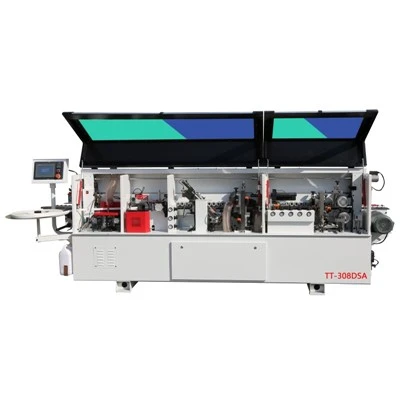
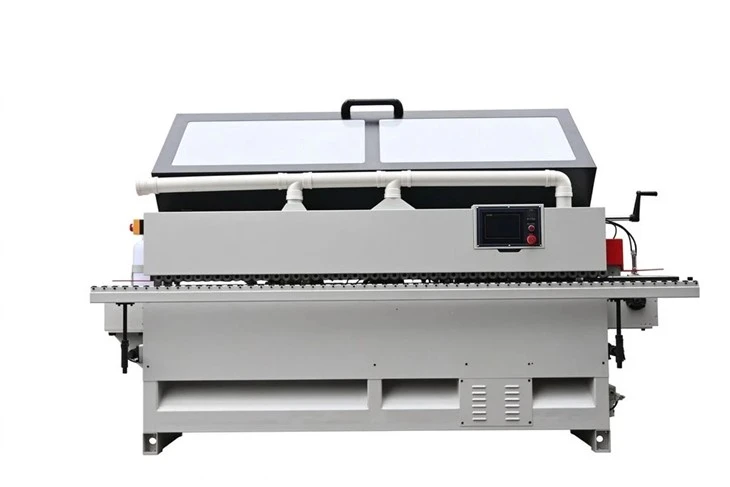
2,580 by 585 mm chassis on a pair of adjustable pads, HMI terminal at the delivery side, shaving ducts spanning the cover.
Four ratings that define the TF
Base chassis ratings, with the extra trim motor counted.
8
m/min, fixed
2
trim motors
120
mm, lowest workpiece
45
mm, heaviest panel
Two Alterations at the Delivery Side
Two alterations, invisible from the far side of an aisle, obvious the instant a component is turned over.
Identical chassis, two distinct answers for the furniture panel edge bander
Any module ahead of the delivery side is DSP specification, unaltered.
A drive on either trim head
0.37 kW at 12,000 rpm on either spindle, which references a panel from one side at a time, not through a common shaft.
A straight blade past the trim
Downstream of the fine trim, a level blade lifts the seam mark and the shine, giving a dull, even plane that holds coating with no ghosting.
The DSP sequence, unaltered
Pre-mill, adhesive and tape, end trim, fine trim, scrape, buff - identical sequence, identical positions.


The Case for Separate Motors
Tie the two toolheads to one motor and the pair becomes a single adjustment. Move one and the partner trails, which makes whatever the setter dials in an average across two sides that may want opposite corrections. The TF cuts that coupling: motor, tool, side - no common element.
The payoff lands at changeover, not on the initial piece. Dial a side, verify it, walk away; no shaft in the train to drift over a working period. It counts most on short components, since at the 120 mm limit the trimmers ride a few centimetres apart - the geometry at which an averaged adjustment gives a ridge a fingernail finds.


Cover open, straight ahead and oblique. At the delivery side either trim head carries a dedicated motor and a dedicated duct. Adhesive pot, pressure rolls and the pre-mill ahead of it remain DSP components.
The Blade the Topcoat Sees
Two fine-trim tools approach the edge from opposing sides and cross at the centre, one for each face of the board. The panel exiting the trim is true, accurate and reflective, carrying a hairline at the point the two cuts intersect. On PVC and ABS that hairline is the thing a finisher's thumbnail locates immediately.
The blade rides a few hundredths of a millimetre below the tape plane. It removes the ridge and the crossing mark in a single pass, hence the result is dull and level - a plane that basecoat, topcoat or veneer holds with no joint printing back. On 0.4 mm tape the benefit is visual; on 2 mm PVC it is the whole distance from an edge that appears tooled to one that appears completed.


Infeed and delivery obliques, cover shut. Assembly sequence places the blade amid the fine trim and the buffing pad; the HMI terminal rides at the delivery side, at sight height.
Specification
TT-306DSPTF spec
The DSP chart, identical apart from the two entries flagged TF.
| Type | TT-306DSPTF |
| Min. panel length | 120 mm |
| Min. panel width | 80 mm |
| Panel depth | 10 to 45 mm |
| Tape width | 0.4 to 2 mm |
| Feed | 8 m/min |
| Pre-mill motor | two 1.1 kW, 12,000 rpm |
| End trim motors (TF) | two 0.37 kW, 12,000 rpm (DSP: one 0.37 kW) |
| Fine trim motors | two 0.35 kW, 12,000 rpm |
| Blade (TF) | Straight, downstream of the fine trim |
| Total draw | 6.23 kW (5.86 kW DSP + extra trim motor) |
| Pneumatic inlet | 0.5 MPa |
| Electrical | 380 V three-phase, 50 Hz (optional) |
| Envelope | 2,580 by 585 by 1,410 mm |
| Net mass | 660 kg |
6.23 kW is the 5.86 kW DSP total plus one 0.37 kW motor; no remaining component was resized. Envelope and mass come from the common chassis, since the blade is a module mounted on it, not an extension of it - mark the aisle against the layout plan issued at purchase.

Full view, cover shut. The shaving ducts on the crown remain the one item that requires planning prior to the furniture panel edge bander being installed.
Space, Electrical and Pneumatics
At 2,580 by 585 mm and 660 kg, this furniture panel edge bander is a free-standing tool, not a production cell. Allow a 6 m aisle, enough for a 2,440 mm panel to feed cleanly, then repeat that clear space at the delivery side so the component exits past the buffing pad. A pair of adjustable pads keeps it on an even slab - no pit, no foundation. Connections: 380 V three-phase at 50 Hz, pneumatics at 0.5 MPa, and chip pickup from the two ducts.
DSP, DSPTF or the Dual-Drive Version
Specify the TF if the taped edge is the exposed exterior of the goods: coated kitchen door facades, 2 mm PVC on open casework sides, shelf boards a shopper removes. If the edge is buried and throughput is the real constraint, the plain DSP turns the identical hour for less capital - the wood panel edge bander page documents that configuration. If the difficulty is a small component and not an exposed facade, the dual-motor automatic panel edge bander is the nearer match, and the straight edge banding machine page documents pre-milling in the tightest aisle.
Prior to signing, conduct one trial. Tape an offcut of the panel really purchased, at the tape width really specified, basecoat it, and sight across the edge beside daylight. A reflective taped edge with a mark down its centre prints past two layers; a bladed edge never prints. Sixty minutes of that resolves if the extra motor and the blade earn a slot on the quotation.
FAQ
Q: How the TF differs from the TT-306DSP
A: Two items at the delivery end. Either trim head gets a dedicated 0.37 kW motor, not one driven from a common shaft, and a straight blade is added downstream of the fine trim. Chassis, feed, pre-milling and tape span stay identical.
Q: Which defect gets removed by the blade?
A: The hairline and the shine that the two fine-trim tools give as the cuts cross. A level blade riding just beneath the tape plane removes the ridge, leaving the edge dull and even - which basecoat, coating and veneer require if the joint is not to ghost past.
Q: Panel and tape spans accepted by this furniture panel edge bander
A: Workpieces from 120 by 80 mm, panel depth from 10 to 45 mm, tape from 0.4 to 2 mm, at a fixed 8 m/min.
Q: Is a separate electrical connection required for the extra trim motor?
A: No. Total draw rises by one 0.37 kW motor, from 5.86 kW to 6.23 kW, and the connection remains 380 V three-phase at 50 Hz with pneumatics at 0.5 MPa.
Q: Is the envelope altered by fitting the blade?
A: The chassis stays 2,580 by 585 by 1,410 mm on this furniture panel edge bander; the blade is a module mounted on it, not an addition to its size. Confirm the value against the layout plan on file, since guarding and duct routing vary by configuration.
Send a Coupon Edge, Get a Spec Pack
Send the tape, the panel depth and the duty the edge faces, and our team returns the module sequence for the furniture panel edge bander, a plan for the aisle, and a price against quantity.
Hot Tags: furniture panel edge bander, China furniture panel edge bander manufacturers, suppliers, factory, automatic edge processing machine, automatic furniture edge banding machine, edge bander with end trimming, edge bander with rough trimming, edge banding machine with glue pot, laser edge banding machine