TingTing Woodworking Machinery Co., Ltd. is one of the leading manufacturers and suppliers of Straight Edge Banding Machine in China. As we have world-leading production equipment and strong manufacturing capabilities, we warmly welcome you to buy premium Straight Edge Banding Machine from our factory. For price consultation, contact us.
A straight edge banding machine works on one geometry: a rectangular panel whose edge runs in a straight line between two square corners. The TT-306DBP takes that panel at 8 m/min and returns it squared, glued, end-trimmed and fine-trimmed, with four stations standard on a single 2,450 mm frame, one operator at the infeed, and the whole line run from a new industrial PC screen.
What decides the finished edge is mostly settled before the panel reaches the glue pot, and what disappoints a buyer is usually settled by two numbers printed in small type: the smallest part and the thickest panel. This page takes the machine in that order. Geometry first, then the heads, the cut that precedes the glue, the cycle time in metres, and the work this machine should not be asked to do.
The TT-306DBP in four numbers
4
stations fitted
8
m/min feed
45
mm max panel
120
mm min part length
What the word straight includes, and what it excludes
Straight covers more of a furniture shop than the name suggests. Carcass sides, shelves, doors, drawer boxes, plinths, worktops and wardrobe panels all present a straight edge, and each of them passes through this machine the same way: located against the fence, held down by the pressure beam, past every head in turn without leaving the line.
It excludes shaped work by definition. A radius corner, a serpentine top or a profile cut on a nesting centre cannot be held against a fence, so the tape goes on with a contour bander or by hand. Shops that build both usually keep the straight parts in-house and send the shaped ones out, because the two jobs need different machines rather than a larger one.
Four stations standard, one more on request
The line, from entry to exit
Each head removes a defect the previous one exposes
Pre-milling
Takes a shallow pass off the edge so the tape bonds to fresh material rather than to a saw cut.
Gluing and tape cut
A spiral chamber lays the adhesive, the tape is pressed on behind it, and the band is cut to panel length.
End trimming
Cuts the band flush at the leading and trailing ends; the approach is set by the panel thickness.
Fine trimming
Removes the overhang above and below the face, adjusted by handle and display at the machine.
Buffing
Polishes the finished edge. Specified as an option on this build, with a flat scraping unit ahead of it when the glue line shows.
The order is not a menu. Trimming cannot follow buffing, and no amount of buffing repairs a cut made by a dull cutter. When a machine is quoted with fewer heads the order stays the same, and the missing station shows up as a defect the buyer finishes by hand at the end of the shift.

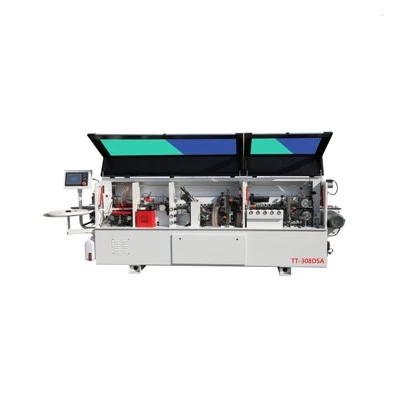
Front view with the hood open: pre-milling at the infeed end, buffing at the outfeed, and the glue pot in the middle of a 2,450 mm frame. The whole line is 600 mm wide, which is why it fits a bench-width space rather than a bay of its own.
Why a straight edge is decided before the glue
A panel saw leaves a cut that looks straight and is not. The blade leaves marks along the edge, tears fibre on the exit side, and can sit a fraction of a degree out of square over a 2,400 mm panel. Tape is 0.4 to 2 mm thick and has no stiffness to spare; pressed onto that surface it follows every mark.
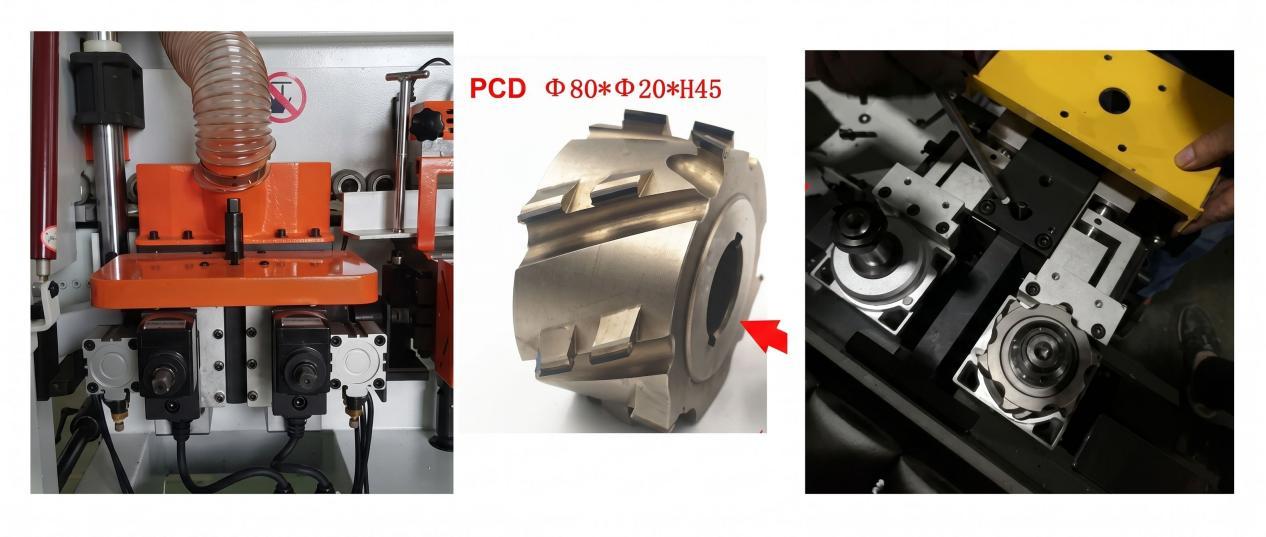
Pre-milling answers with two 1.1 kW motors at 12,000 rpm driving a PCD cutter of 80 mm diameter. It takes a shallow pass, squares the edge to the fence line and leaves a face the adhesive can wet evenly. On melamine, veneer, and any board that came off a panel saw, this is the station that decides whether the joint line is visible at all.
Planed solid wood is the one common exception. Where the edge is already clean and square, the pass removes good material for no gain, and a machine without pre-milling is a reasonable purchase.
Left: the pre-milling unit in place. Centre: the 80 mm PCD cutter that squares the edge. Right: the end-trimming heads. Each one cuts against a fixed reference, which is why the base under them is heavy and why a worn insert shows as a line on the edge rather than as a wobble.
Keeping the panel on the line
Every head assumes the panel is where the fence says it is. Three things hold it there: a wide infeed fence that carries the full panel height, a pressure beam that grips a 10 mm panel and a 45 mm panel without shimming, and a material-limiting cylinder at the entry that keeps the end-trimming unit out of reach of a panel fed at an angle.
The fourth is mass. The end-trimming unit sits on a heavy base because its cutter indexes off a fixed reference. When that base flexes, the cut drifts panel by panel instead of failing outright, which is hard to spot in a demonstration and easy to spot in a container of two hundred doors.
A gear-motor reducer is fitted as standard. That is what lets a 2,400 x 1,200 mm panel feed at a constant 8 m/min instead of the surges a plain chain drive produces.
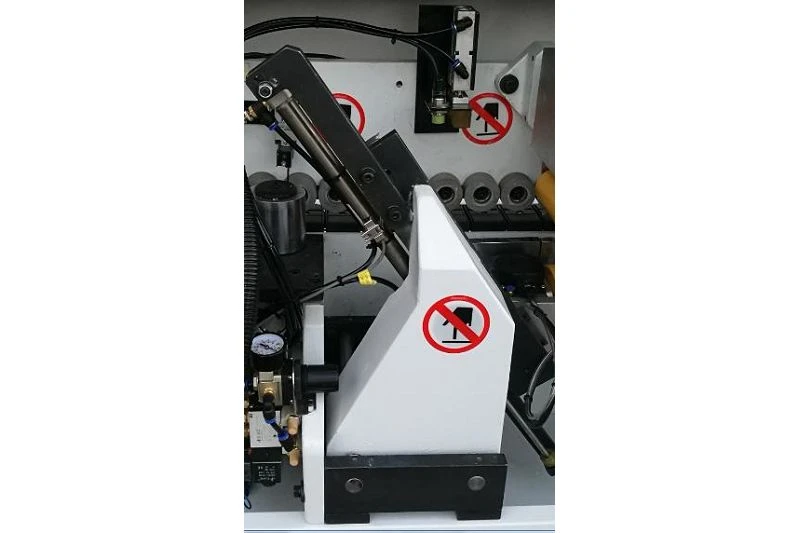
The end-trim head sits on the heaviest casting in the line because it indexes off a fixed reference; a few tenths of flex in that base shows up on every end of every panel.
Cycle time counted in metres, not panels
The feed runs at 8 m/min, which is 133 mm of edge per second. Convert the perimeter of a part and you have its banding time, before any handling.
Banding time by part
Perimeter divided by 133 mm per second, four passes per panel
| Drawer box side, 300 x 200 mm | 1.0 m of edge, about 8 s |
| Shelf, 600 x 400 mm | 2.0 m of edge, about 15 s |
| Cabinet side, 720 x 560 mm | 2.6 m of edge, about 19 s |
| Wardrobe side, 2,400 x 600 mm | 6.0 m of edge, about 45 s |
| Kitchen run, 40 parts | about 88 m, roughly 11 min |
Those are machine times. On small parts, three re-orientations and stacking cost more than the pass itself, so the layout around the machine decides the real output; on 2,400 mm parts one person cannot turn the panel alone.
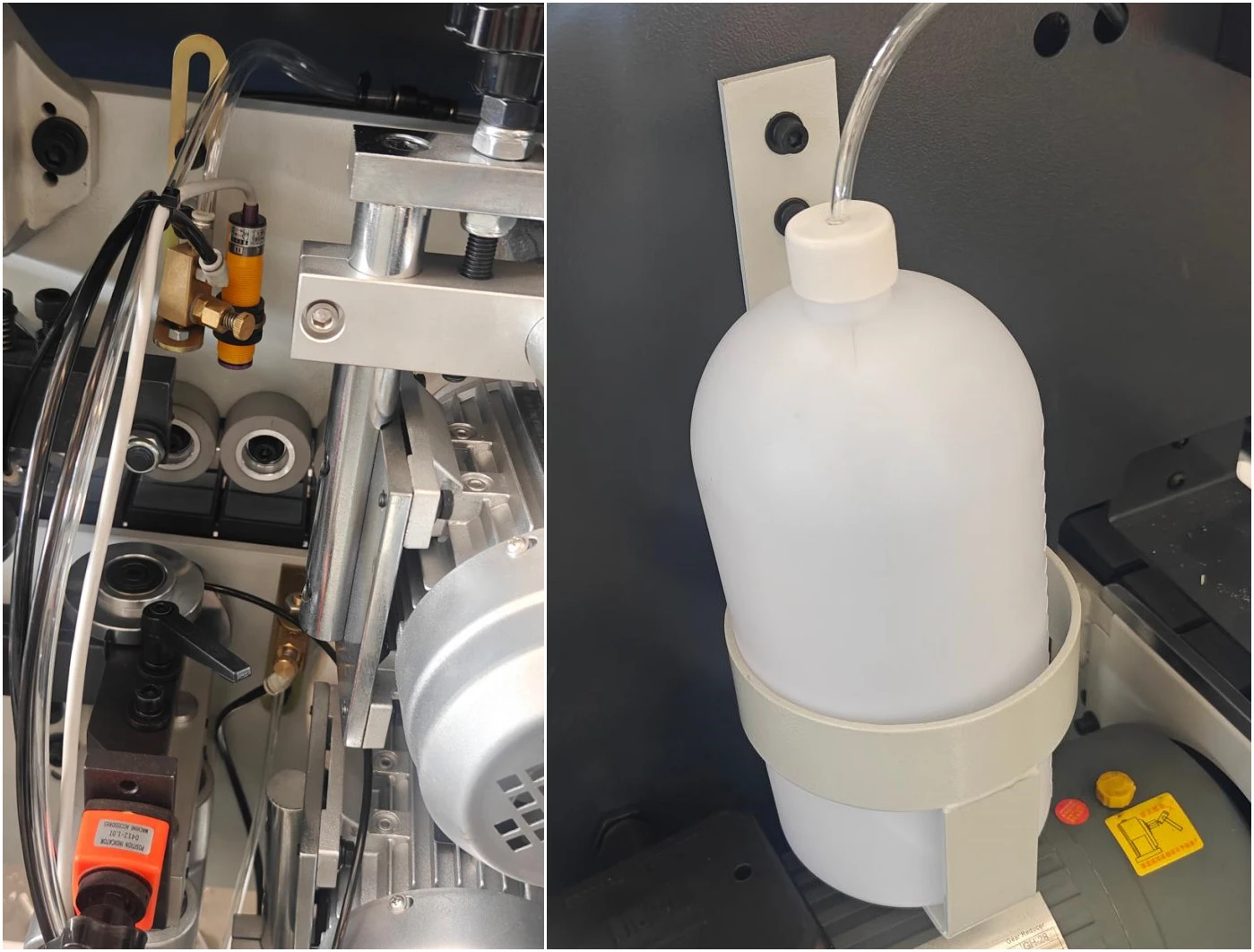
Fine trimming on the left, air preparation on the right: the two places a technician touches during a thickness change.
The industrial PC screen, and what it changes at the machine
This build is supplied with the new industrial PC panel rather than the older button-and-keypad controller. The whole head line is drawn on one page as icons, in the order the panel meets them, and each head is switched on or off from the screen. There is no row of station switches to read first and no legend to memorise: the operator taps the picture of the unit they want to stop using.
Four pages cover the working day. The control page is the station line itself. The parameter page holds the values that change with the material, so a shift from 18 mm board to 25 mm board is a page and a number, not a set of mechanical references hunted one by one. The manual control page is what a fitter uses with the hood open, moving a single unit without running the line. The language button sits on the same strip, so a new operator can work in their own language without a printed manual.
The screen also counts. A panel counter and a metre total sit on the right of the station page, each with its own reset, so a shift total or a batch total is read off the machine instead of counted by hand at the end of the day. Glue temperature keeps its own display on the panel below the screen, one glance away, because that is the number an operator checks most often.
Five things the screen puts in one place
The pages an operator actually uses
Control page
The head line as icons. Each station is enabled or disabled by tapping it, without opening the hood.
Parameter setting
Thickness, feed and unit values held per job, so a material change is a page rather than a mechanical reset.
Manual control
Runs a single unit for setting up and fault finding while the rest of the line stays still.
Language
Changed from the screen, so a new operator is not reading a translated printout taped to the frame.
Counter and meter
Panels and linear metres on the same page, each with a reset, for shift totals and batch totals.
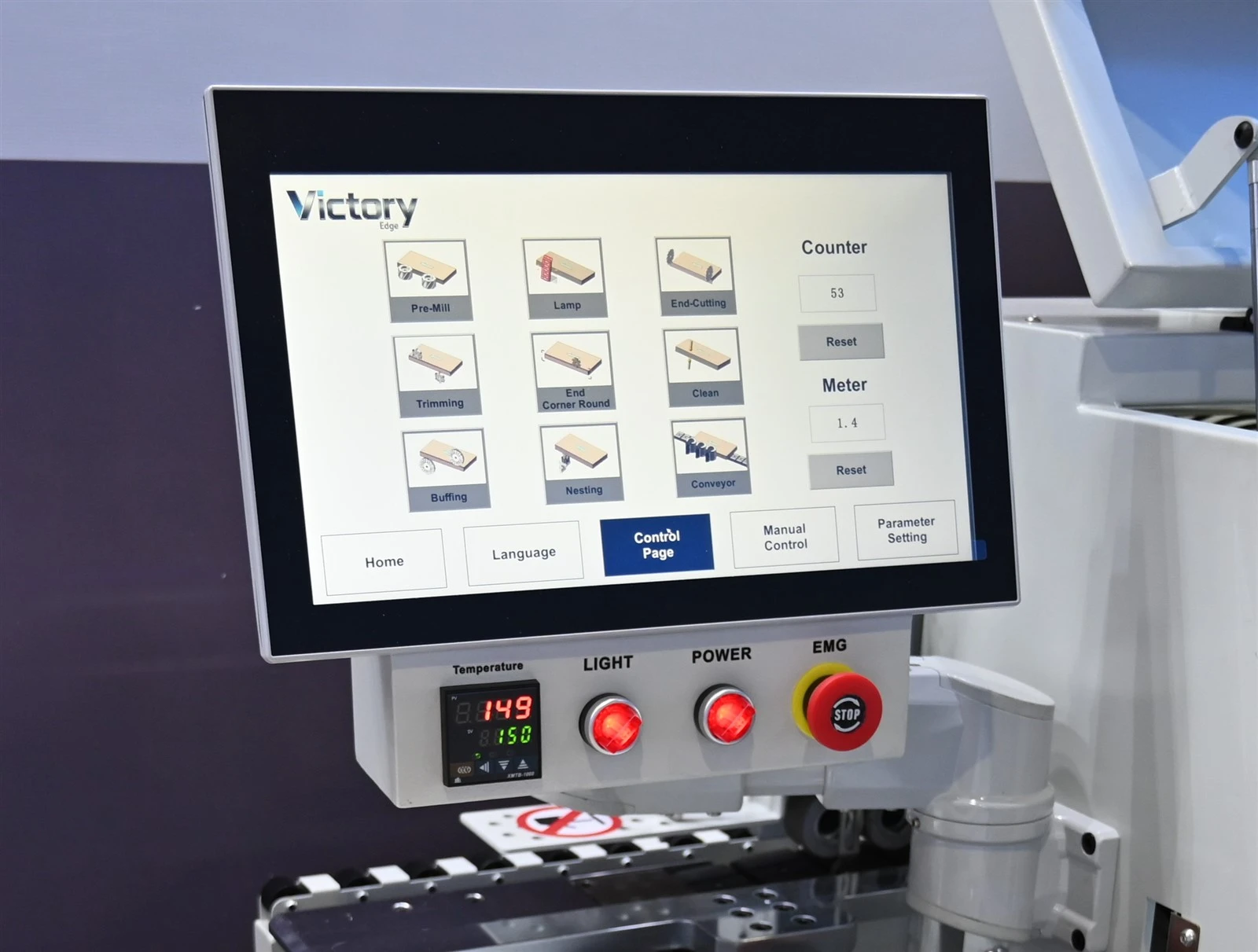
The new panel: the station line on the left as icons, counter and metre total on the right, and the page buttons along the bottom. Glue temperature stays on its own display under the screen.
Watch the line run
Where a straight edge banding machine stops
This build has no corner rounding unit. The tape ends are trimmed flush and stay square. On carcass work nobody sees them; on a drawer front or a door they are the first thing a customer touches. Where rounded corners belong to the product, the TT-306DSA carries a corner rounding head with servo profile tracking on the same platform.
Three numbers end the discussion faster than any feature list: parts below 120 x 80 mm, panels thicker than 45 mm, and band heavier than 2 mm. Outside those limits the part is finished by hand or on another machine, whatever the head count says on the brochure.
Configuration settled before the frame is built
Voltage, frequency, screen language and every optional unit are fixed at order because they are built into the machine rather than bolted on afterwards. The 380 V 50 Hz three-phase supply is standard; 220 V and 415 V are built to order, as are the optional buffing and flat scraping unit, the cleaning unit, pre-heating for cold workshops, and the nesting function on the fine trimming head.
The cabinet behind the panel is assembled from parts an electrician can name: an LS PLC, a Shihlin SC3 inverter, contactors and a standard relay set. That is worth little on delivery day and worth a great deal on the day something stops.
LS PLC, Shihlin SC3 inverter, standard contactors. Identifiable parts mean a local electrician can order a replacement instead of waiting on a proprietary module.

Specification of the standard build
TT-306DBP technical data
Confirm voltage, frequency and optional stations before production
| Model | TT-306DBP |
| Min. panel length | 120 mm |
| Min. panel width | 80 mm |
| Panel thickness | 10-45 mm |
| Edge band thickness | 0.4-2 mm |
| Feeding speed | 8 m/min |
| Input voltage | 380 V, optional |
| Input frequency | 50 Hz, optional |
| Pre-milling motor | 2 x 1.1 kW, 12,000 rpm |
| End cutting motor | 0.37 kW, 12,000 rpm |
| Fine trimming motor | 2 x 0.35 kW, 12,000 rpm |
| Total power | 5.86 kW |
| Air pressure | 0.5 MPa |
| Overall dimension | 2,450 x 600 x 1,410 mm |
| Net weight | 660 kg |

Plywood case, cutters packed separately.
What this machine sits between
A bander is almost never the only purchase in the decision. Our edge banding machine types guide sets out how straight, curved and double-sided work divide before a model is chosen; the pre-milling model page compares head counts on the same chassis; and the TT-308DSP is the higher-output build at 8.15 kW with 8, 12 and 16 m/min when the feed, rather than the operator, becomes the bottleneck.
Machines assembled and run before packing, in the same workshop in Changshu where the frames are machined. A configuration change is a build instruction here, not a request to a third party.

Questions about the TT-306DBP
FAQ
Q: What is a straight edge banding machine?
A: A machine that bands panels whose edge is a straight line between two square corners. The panel runs against a fence past a fixed line of heads. Radius and profile work needs a contour bander instead.
Q: Can this model band curved edges?
A: No. The fence and the pressure beam both assume a straight reference, and the heads index off that line. A curved part has to be banded on a contour machine or by hand.
Q: What is the smallest part it can run?
A: 120 mm long by 80 mm wide, with panel thickness from 10 to 45 mm and edge band from 0.4 to 2 mm. Below that size the pressure beam cannot hold enough of the panel for a clean end trim.
Q: Does it round the corners of the edge band?
A: Not on this build. The band is trimmed flush at both ends and stays square. Corner rounding with servo profile tracking is fitted to the TT-306DSA on the same platform.
Q: How many panels per hour will it do?
A: Banding time is perimeter divided by 133 mm per second, so a 720 x 560 mm cabinet side takes about 19 seconds of machine time across four passes. Handling and turning usually take longer than the banding, which is why shift output depends on the layout.
Q: What power supply does it need?
A: 380 V, 50 Hz, three-phase as standard, with 220 V and 415 V built to order. Total connected power is 5.86 kW and the pneumatic supply is 0.5 MPa.
Q: What control screen does the TT-306DBP use?
A: The new industrial PC panel, not the older button-and-keypad controller. The station line, parameter page, manual control and the language switch all sit on one screen, with a panel counter and a metre total beside it.
Send a part list, get a build
Longest part, smallest part, thickness range and the tape you run. Send those four answers and we will confirm what this straight edge banding machine needs to be built with, and when it can ship.