Search for an edge banding machine and the results look like one long product family. In practice the category splits along four independent axes, and two machines that look similar on a spec sheet can sit at opposite ends of all four. Buying the wrong axis is expensive, because it cannot be fixed afterwards with a better cutter or a new glue.
This page sets out the four axes in the order they eliminate machines, then shows where each type stops being the right answer.
The four axes that split the category
4
independent axes
2
panel geometries
7
stations in a full line
3
ways to bond tape
Axis one: straight parts or shaped parts
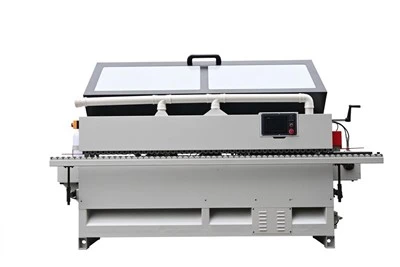
A straight-line machine assumes the edge is a straight line between two square corners. The panel runs against a fence, a pressure beam holds it down, and every station works on the same plane. That assumption covers cabinet doors, carcasses, shelves, drawer boxes and worktops.
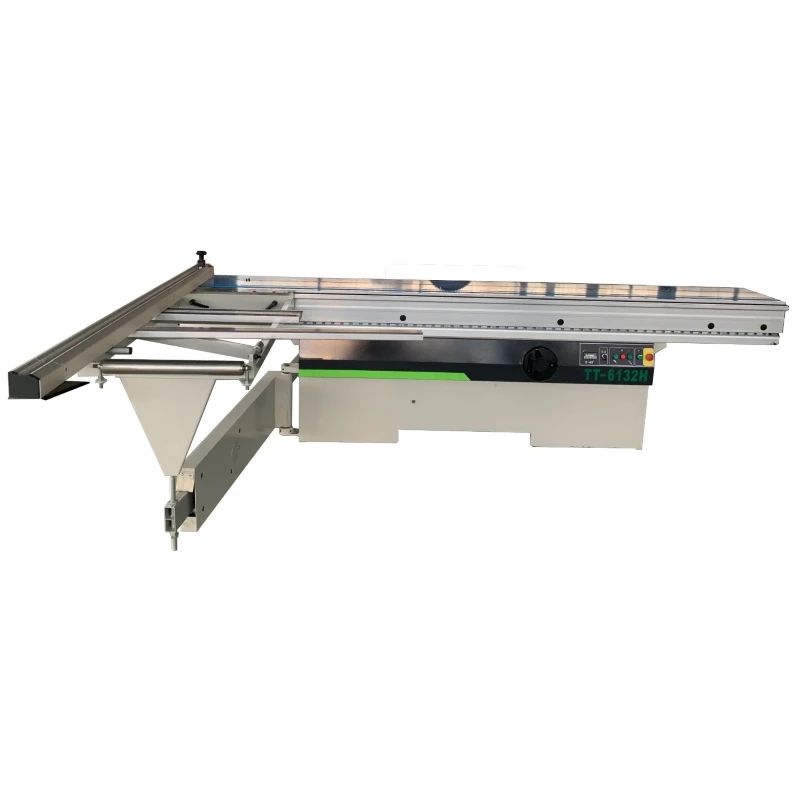
Curved work breaks it. A shaped table top, a radius corner or a serpentine panel cannot be fed against a fence, so the tape is applied by a contour bander or by hand, with a small glue pot and a roller that follows the profile. The output is measured in metres per hour, not metres per minute, and the operator's hand is the feed.
Most workshops own a straight-line machine and subcontract the curved parts. Buying a contour bander only makes sense when shaped edges are a product line, not an occasional request.
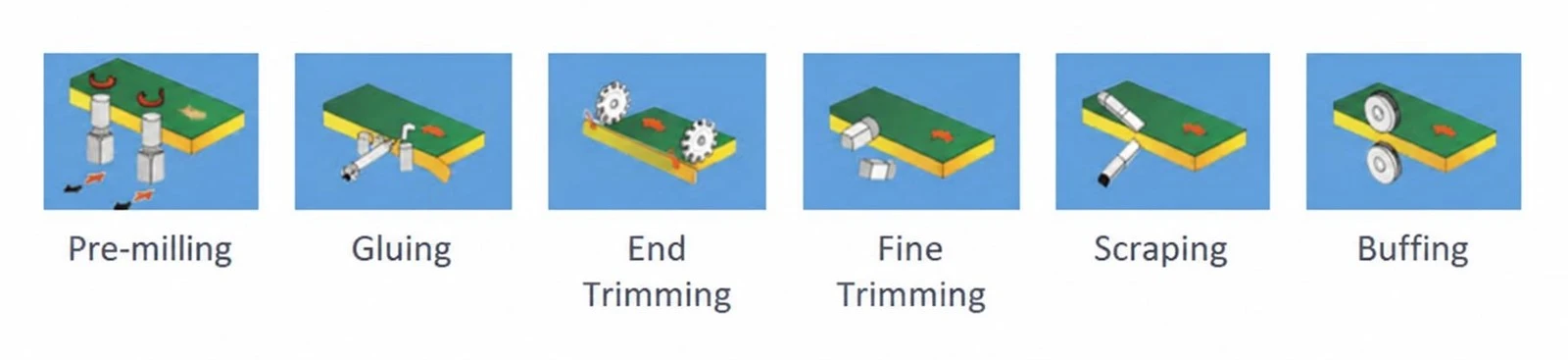
A full straight-line sequence: pre-milling, gluing, end trimming, fine trimming, scraping, buffing. Curved work skips most of it and keeps the glue.
Axis two: one edge per pass, or two
A single-sided machine bands one edge, and the operator turns the panel for the next. On a 600 mm deep carcass side that is four passes and three turns, and the turning is usually the slowest part of the cycle.
A double-sided machine puts a second glue pot and a second trimming line on the other side of the bed, with a return conveyor carrying the panel back. Two edges leave in one pass. It costs roughly a second machine in money and floor space, and it removes the turn from the cycle entirely.
The dividing line is not volume alone. It is panel size and weight: a 2,400 mm side that takes two people to turn is a different problem from a 300 mm drawer front that one hand can flip.
Axis three: how many stations are on the line
Station count is the axis buyers compare first and understand last, because it is quoted as a number and felt as a routine. Every extra unit removes one defect and adds one more setting to check at changeover, so the right count is the lowest one that leaves no defect for the operator to repair by hand.
The cost of getting it wrong shows up as labour, not as scrap. A shop that repairs edges at the bench pays for the missing unit every shift, in a job that never appears on a quote. A shop that bought units it does not need pays once, and then pays again at every changeover. The station-by-station process is covered in our edge banding guide, so this page stays on the choice between types.
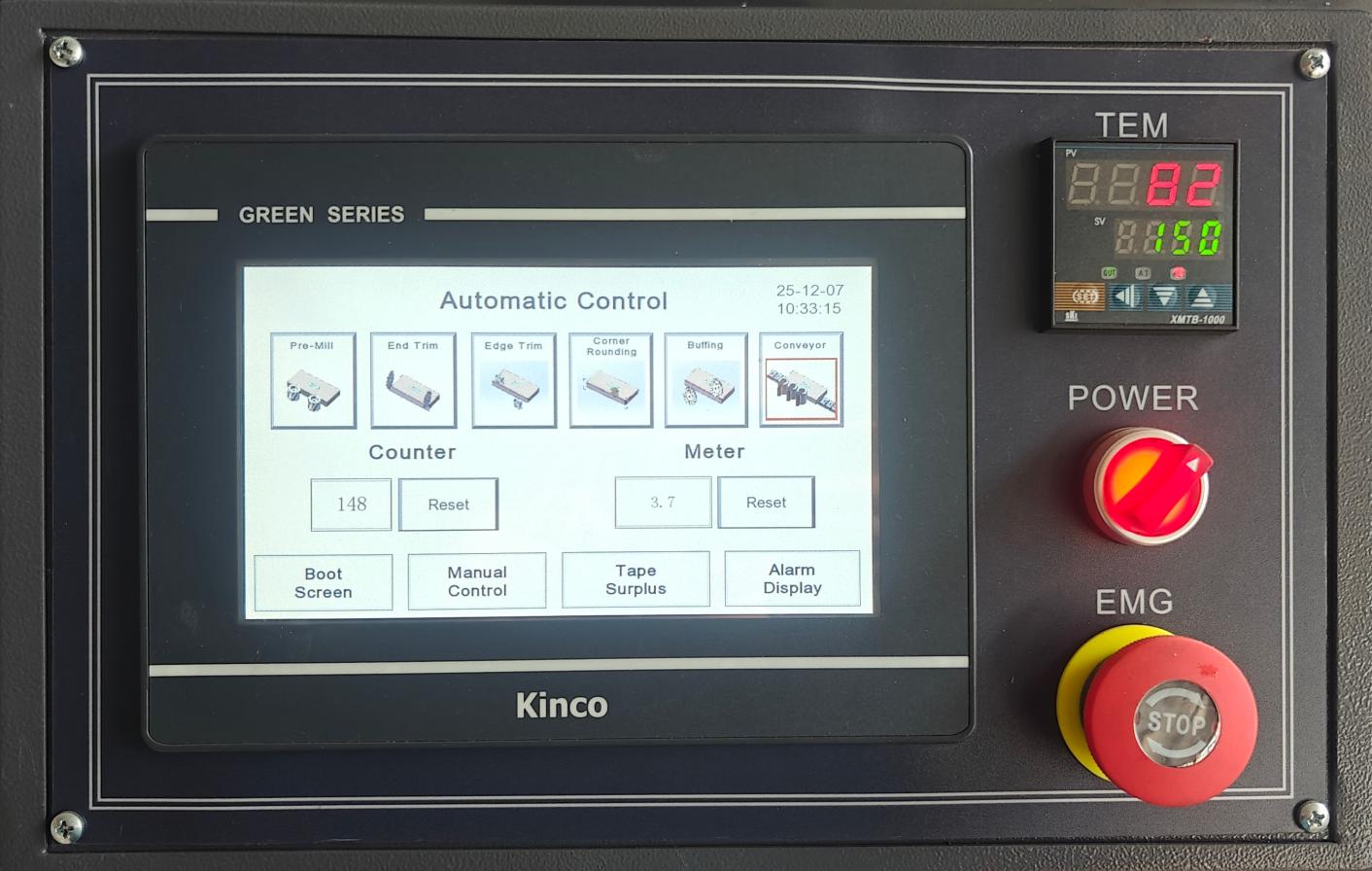
The station icons on the controller are the configuration: what the line finishes without a hand tool.
Axis four: what bonds the tape
Three bonding methods reach a small or mid-size shop: EVA hot-melt, PUR hot-melt and a laser or hot-air unit that activates a functional layer on the tape itself.
- EVA is the default. It melts, flows, sets on cooling and tolerates a wide range of workshop conditions. It also softens again under heat, which matters for a kitchen run beside an oven.
- PUR reacts with moisture and cannot be re-melted. It holds through heat and humidity, needs a clean glue circuit at the end of every shift, and costs more per metre.
- Laser and hot-air units produce a joint with no visible glue line, because there is no glue. They need tape with a functional layer and a machine built for it; they are a different purchase, not an upgrade.
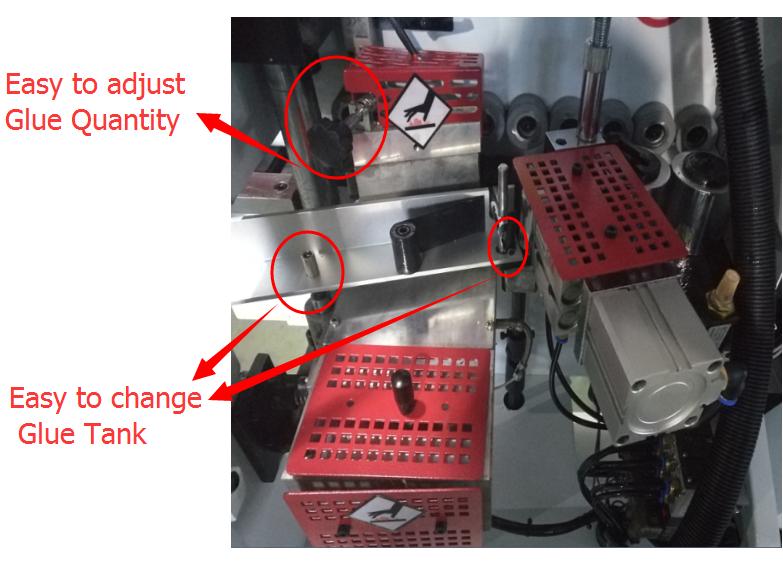
Glue quantity and tank access are the two settings that decide a visible line. On this unit both are adjusted from the front of the machine, without tools.
Where the types stop fitting
Each axis removes machines quickly once the real constraints are written down.
Type by panel mix, not by brochure
Find your row, then read the exclusion
| Straight cabinet parts, one shift, one operator | Single-sided, 4 to 6 stations |
| Straight parts, two edges, high daily volume | Double-sided with return conveyor |
| Visible edges in melamine or veneer | Pre-milling plus corner rounding |
| Shaped or radius parts as a product line | Contour bander, separate from the line |
| Heat or humidity in service (kitchens, bathrooms) | PUR, not EVA |
Two exclusions are worth stating plainly. A single-sided four-station machine cannot produce a zero-glue-line edge, whatever the cutter. And a double-sided line cannot pay for itself on short runs, because setting both sides for a 40-piece batch costs the same as setting one.
Setup is the hidden variable in every comparison. A single-sided line needs one width setting and one tape change; a double-sided line needs both sides matched, which doubles the changeover and does not halve it. On a run of forty pieces, that difference can outweigh the pass it saves. On a run of four hundred, it disappears.
The specification that eliminates most machines
Minimum part size is printed in small type and decides more purchases than power does. On the automatic machines we build, the minimum panel is 120 mm long and 80 mm wide, with panel thickness from 10 to 45 mm and tape from 0.4 to 2 mm.
If your work includes 80 mm drawer sides or 100 mm fillers, that number is the one to test first. Below it, the part is held by less of the pressure beam and the end-trimming heads cannot get a clean approach, so the edge is finished by hand regardless of how many stations the machine has.
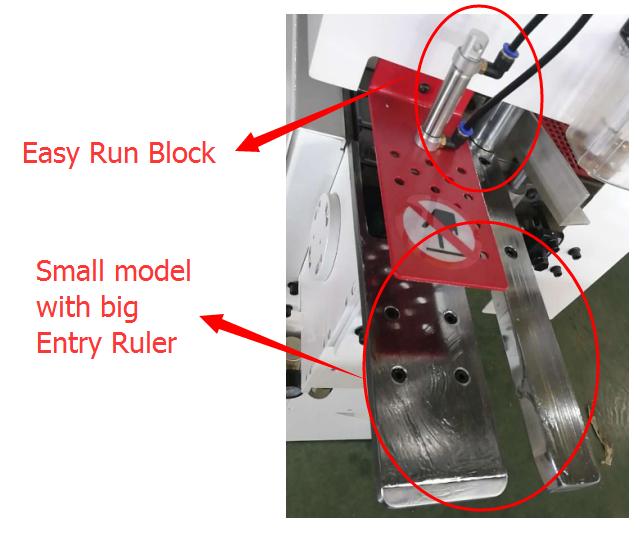
A wide infeed fence and a quick-set run block decide how long a width change takes.
What to check on the machine itself
- The entry ruler and run block: a wide infeed fence and a quick-set block decide how fast a new width is set up.
- Glue pot access: if the tank cannot be reached and cleaned in minutes, it will not be cleaned.
- Pressure beam travel: it should hold a 10 mm panel and a 45 mm panel without shimming.
- End-trimming approach on the shortest part you make, not on the demonstration panel.
How batch size changes the answer
Batch size decides whether a wider machine pays. Take two shops with the same panel mix. The first runs forty pieces per size, the second four hundred. Both need the same edge quality, so both need pre-milling. The difference is what changeover costs them.
For the first shop, every new width means setting the fence, the pressure beam and the trimming heads, then running a test piece. Ten changeovers a day is most of a shift, and a second side to match doubles each one. The machine that saves a pass loses more in setup, so a single-sided line with fast changeover wins on paper and on the floor.
For the second shop, changeover happens twice a week. The saved pass compounds across four hundred pieces, and the return conveyor keeps the operator at the infeed instead of walking around the bed. Same edge, different arithmetic, and it is the arithmetic that should decide the type.
There is a third case that neither shop sees until later: mixed batches, where the panel changes but the edge does not. That work rewards quick tape and glue access more than it rewards station count, which is why a well-laid-out six-station machine can outrun a badly laid-out nine-station one on the same order book.
Questions that come up when comparing types
FAQ
Q: Is a double-sided machine twice as productive?
A: For two-edge work it removes the turning and the second pass, so a cycle that took four passes takes one. In practice the gain is closer to 40 to 60 percent, because loading and unloading still take the same time.
Q: Can a straight-line machine band curved parts?
A: No. The fence and pressure beam assume a straight edge. Radius work needs a contour bander or hand application.
Q: When is pre-milling worth the extra station?
A: When the panel edge leaving your saw is not clean enough to hide under tape. On melamine and veneer that is most of the time; on solid wood it often is not.
Q: What is the smallest part these machines can run?
A: On our automatic machines, 120 mm long by 80 mm wide. Smaller parts are usually banded by hand or on a dedicated small-part unit.
Q: EVA or PUR?
A: EVA unless the finished product lives in heat or humidity. PUR costs more per metre and needs daily cleaning of the glue circuit, and it earns that on kitchens and bathroom furniture.
Q: How many stations do I need to start?
A: Gluing, end trimming and fine trimming as a minimum. Add pre-milling before corner rounding, and add scraping and buffing only when the edge is visible on the finished product.
Choosing between the types
Write down four things before comparing any two machines: the longest and shortest part you band, how many edges per panel, whether the edge is seen, and where the furniture will live. Those four answers eliminate most of the catalogue. The remaining choice is usually between two station counts on the same chassis, which is a much easier conversation.
Send us your part list
The longest part, the shortest part, and how many edges per panel. We will tell you which type fits, and which stations you can leave off the order.