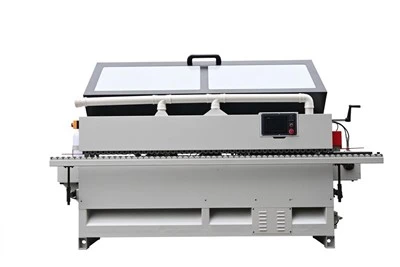
Two sliding table saws can sit side by side on a showroom floor, look almost identical, and differ by a factor of three in price. The difference is not the brand on the cabinet. It is five or six decisions taken at the design stage, and most buyers only find out which ones were taken after the machine is in the workshop.
This guide walks through those decisions in the order they matter, and says plainly when a feature is worth paying for and when it is not.
The numbers that frame every decision
3
machine classes
6
price decisions
120
mm
max cut depth
3
safety habits
Three machines that get called the same thing
A contractor saw has the blade on a folded steel top and a fence that clamps to a rail. A cabinet saw puts the same blade under a cast iron top, with the motor hanging behind. Neither moves the panel: the operator pushes it past a fixed blade, and the panel is unsupported the moment it leaves the front edge.
A sliding table saw adds a carriage. The panel is clamped to a table that travels on rails beside a fixed top, so the board is held from the first millimetre of the cut to the last. That single change is what makes a full 2,440 x 1,220 mm sheet a one-person job.
Everything below follows from that difference, including the price.
The six decisions that set the price
Two machines with the same footprint can differ on all six. Each one moves the price and changes what the machine can do:
What actually drives the cost
Six choices, taken before the machine is built
Carriage length
Between 1,600 and 3,200 mm. It fixes the longest panel you can break down in a single pass.
Carriage width
320, 380 or 435 mm. The wider the carriage, the more of a heavy board sits on metal rather than overhanging.
Table build
Pressed steel, aluminium extrusion or cast iron. It decides how the machine sounds under load and how it holds flat over years.
Guide type
Round bar, dovetail or profile rail. The profile rail wears least and costs most; the round bar is cheapest and needs the most attention.
Scoring unit
A second motor on its own arbor, or nothing at all if you never cut faced board.
Motor size
3 kW on short-carriage machines, 5.5 kW on long ones cutting 18 to 25 mm board all day.
Carriage length: fix this before anything else
Start with the longest single cut you make in a week, not the biggest sheet you occasionally handle. A 3,200 mm carriage takes a full sheet with the clamp behind it and the offcut still supported. A 1,600 mm carriage takes the same sheet in two passes, which is fine once a month and a slow habit twice a day.
Length also sets the floor. The carriage needs clear travel at both ends plus room to walk beside it, so a long machine in a short room ends up with the outrigger against a wall.
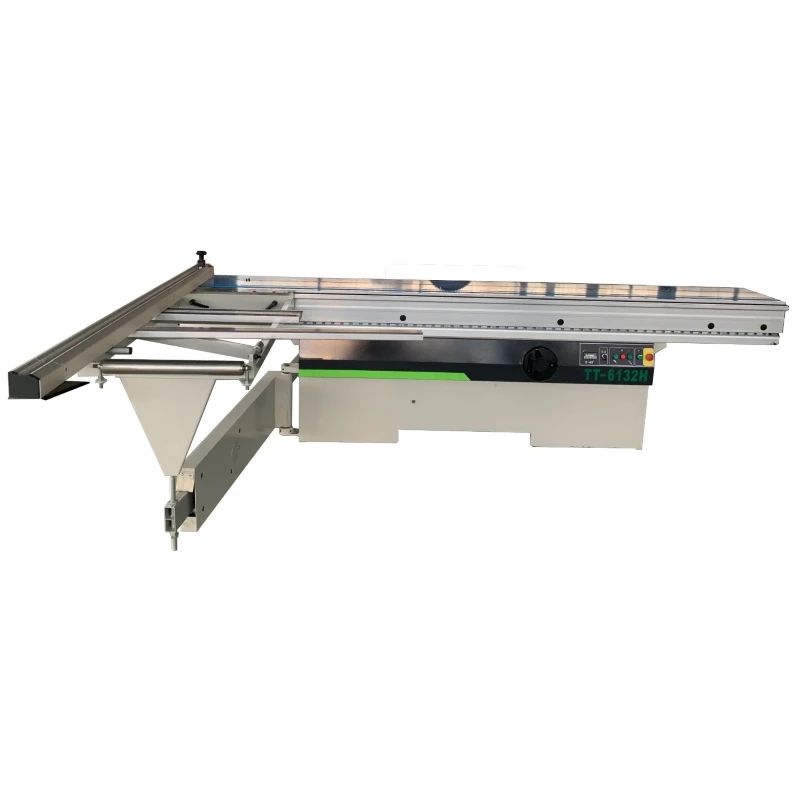
A 3,200 mm carriage with the outrigger fitted. The table, not the operator, carries the panel through the cut.
Width: 380 or 435 mm
Width is the quiet specification. A 380 mm carriage holds a sheet at the clamp line and lets the front edge hang. A 435 mm carriage puts another 55 mm of metal under that edge, which is where a heavy board dips and where an operator's leading hand normally ends up taking the weight.
The section drawing is the honest way to compare: overall width, depth and the bore spacing that carries the roller cage can be measured on a delivered machine with a caliper, not taken from a brochure.

The carriage section: 398 mm across the top face, 230 mm deep, 328.5 mm at the base. Depth is what resists twist when a sheet overhangs.
Scoring: pay for it, or do not
Faced board chips on the underside because that is where the main blade exits, lifting the laminate as the teeth come through. A scoring blade is a small saw running ahead of the main one, cutting a shallow groove so the exit edge is already separated.
Buy the scorer if you cut melamine, veneer, acrylic or aluminium composite and the edge is visible. Skip it if your work is solid wood, painted MDF or construction ply where the underside never shows. The unit adds a motor, an arbor and one more depth setting to get right.
Two blades on separate motors. The scorer cuts first and shallow; the main blade then breaks through an edge that is already clean.

Guides, and where accuracy goes
Round bars are cheap and adjustable, and they wear into an oval that shows up as a carriage that rocks. A dovetail gib holds better but needs re-shimming as it wears. A profile rail with sealed blocks carries load in four directions and keeps the carriage square until the wipers stop doing their job.
On a used machine, check three things before anything else: play in the carriage when you lean on the far end, the condition of the wiper strips, and whether the scorer still tracks the main blade through the full tilt range.
Which class fits the work
The table below is the shortcut version we use on the phone, before anyone talks about a model number.
Match the machine to the work, not the other way round
Read your own week, then take the row
| Kitchen carcasses in 18 mm melamine, 30 to 60 sheets a week | Long carriage, scorer, 5.5 kW |
| Solid wood doors and frames up to 80 mm | Shorter carriage, no scorer, 4 kW |
| Site work and mixed sheet goods | 1,600 mm carriage, 3 kW, mobile base |
| Hundreds of identical panels every day | Beam saw or nesting centre, not this class |
What goes first, and what does not
Belts, rollers and wiper strips go first, because they are consumables doing dirty work. Contactors and scoring bearings follow. Cast iron, aluminium extrusion and a forged arbor do not wear out in a workshop, which is why they are worth paying for once.
The pattern of failure is predictable enough to plan for: keep one spare belt, a set of wiper strips and a contactor on the shelf, and a machine that would otherwise lose a week loses an hour.
Three habits that prevent most injuries
- A push stick for anything closer than a hand's width to the blade, every time, including the last cut of the day.
- The riving knife in the kerf before the first cut, not after the first pinch.
- Hands flat on the carriage and never in line with the blade, including while reaching for the offcut.
The guard is a backstop for those habits, not a replacement for them. It should be set to the thickness of the material, not left at the height of the last job.
Floor, power and dust before you order
- Floor: level within a few millimetres over the machine's length, and clear travel for the carriage at both ends.
- Power: three phase at the site, with the cable size matched to the motor rather than to what the old machine used.
- Dust: a 100 mm port under the table needs real air volume. A shop vacuum will keep the floor tidy and leave the fine dust in the air.
Testing one before you pay
Ask for a test cut on your own material, not on the demonstrator's offcut. Bring a piece of the board you cut most, and a square.
Then check four things in this order. Push a full sheet through and listen for a change in pitch at the point where the panel leaves the carriage. Put a square on the cut edge, both ways. Cut the same dimension twice and compare. Then tilt the saw to 45 degrees and make the same cut again: a machine that is square at 90 and out at 45 has a problem in the trunnion, and it will not show up in a showroom.
Finally, ask what is in the crate and what is not: blades, scorer, outrigger, manual, spare wipers. It is a cheap question that changes the delivered price more than the discount does.
Questions we get asked before an order
Is a sliding table saw worth it for a small shop?
If you break down sheets more than a few times a week, yes. The gain is not speed, it is that one person can handle a full sheet without a second pair of hands and without the cut drifting.
How long a carriage do I need?
Measure the longest single cut you make in a normal week, then add the clamp. A full 2,440 mm sheet needs a 3,200 mm carriage to stay supported.
Do I need a scoring blade?
Only if the underside of the cut is seen or veneered. Melamine, acrylic and aluminium composite chip without one; solid wood and painted MDF do not care.
Can one person load a full sheet?
On a long carriage, yes. The panel slides onto the table and the clamp takes it from there; the operator guides rather than lifts.
What maintenance does it need?
Wipe the rails, check the wiper strips, keep the scorer depth right and listen for a change in the belt. The rest is inspection, not servicing.
Why do two machines with the same size cost so different?
Carriage width, table material, guide type, scoring unit and motor. The footprint tells you almost nothing about the build.
Where to go next
If you already know your carriage length and whether you need a scorer, the two 3,200 mm machines we build are described in detail: one is a cast iron machine for shops running all day, the other is the lighter build for mixed work. If you are still deciding, send the panel sizes and the weekly volume and we will tell you which class fits, including when the answer is not a sliding table saw at all.
Send the panel sizes and the weekly volume. We will tell you which specification the work actually needs, and when a cheaper machine is enough.