TingTing Woodworking Machinery Co., Ltd. is one of the leading manufacturers and suppliers of automatic panel edge bander in China. As we have world-leading production equipment and strong manufacturing capabilities, we warmly welcome you to buy premium automatic panel edge bander from our factory. For price consultation, contact us.
Most pages about this class of machine walk from the infeed to the outfeed and stop at the specification table. This one starts from the part list instead, because the TT-306DBT is bought for one problem: a cabinet shop whose work is made of small parts - drawer boxes, dividers, face-frame rails, lippings - where the question is not how fast the machine runs but whether the part can be run at all.
TT-306DBT, in working numbers
2
end-trim drives
80
mm min part length
4.75
kW connected
8
m per minute
Where a short part actually fails
Put a 100 mm drawer side through a single-motor end trimmer and the two trimming heads are working within a hand's width of each other, both set from the same reference. The part's two ends then become the compromise: one comes out clean, the other carries a step of a few tenths, or both sit slightly proud of the face.
A step that small is not a measuring problem, it is a fingernail problem. A customer feels it on the first drawer they open, long before anyone puts a caliper on it - and on a cabinet run, one bad end per part multiplies by the number of drawers in the order.
Two trim heads on the same line, each carrying its own motor and its own dust hose. Nothing mechanical ties the setting of one head to the other, which is the whole point of the build.

Two motors, one setting each
With a motor behind each head and a direct drive to the cutter, setting a trim is a local job: adjust one head, look at one end of a test part, move to the other. There is no link to split the difference across, and nothing between motor and cutter to wear, drift or be re-tightened after a long run - so a setting made at the start of a shift is still the setting at the end of it.
Drawer boxes: the list that pays for the machine
A 350 x 150 drawer side is the part that decides most of these purchases. Two of them, two 400 x 150 fronts and backs, and a 400 x 350 bottom make one box of five parts; a kitchen with eight drawers is forty small parts, and a twenty-kitchen order runs to eight hundred.
Band those before boring, not after. Boring first leaves a hole within a few millimetres of the banded edge, and a trim head running past an open hole is where chips and torn tape come from. Banding first, then drilling on the same reference, keeps both operations honest.
Assembly follows the same order. Holes, dowels and KD fittings are placed off the banded edge, so the cabinet goes together against a surface that is already finished - and a box that is square on the bench stays square when the drawer is fitted, instead of being pulled true by the runners.
It also settles the stacking question. Eight hundred parts at 350 mm cannot be stacked in one pile at the outfeed: two piles, one either side of the operator, and a first-off part checked at the start of each pile. That is the whole method, and it is why a machine that takes the part without a second operator matters more on drawer work than a machine with a faster feed.
A part list, costed by the metre
On an automatic panel edge bander, small parts are quick to cost, because nearly the whole perimeter is edge. A 350 x 150 drawer side is one metre of band, about eight seconds at the feed; a 2,000 x 22 lipping is four metres, about half a minute. Two hundred drawer sides come to 200 m and roughly 25 minutes of machine time.
Two habits decide whether that half hour stays a half hour. The first is a first-off panel after every tape or thickness change: band one part and check both ends by hand before the run starts. The second is a fixed stack position at the outfeed, because on a 350 mm part the operator spends more time turning and stacking than the machine spends feeding.
Whichever list you run, the banding is a fraction of a shift. The rest goes on handling: picking, turning, stacking, and walking between the outfeed and the next pile. That is where the cost of small parts sits, and it is why a machine that can take them without a second operator changes the day more than a faster feed would.
What changes between two cabinet runs
In practice four things move between orders: panel thickness, tape width and colour, glue level and trim position. The first three are set at the pot and the entry; the fourth is the one this build makes easier, because each head is set on its own. A thickness change becomes two short adjustments at two heads rather than one adjustment that has to satisfy both ends.
Options are built in at order rather than added later, so they never enter the changeover conversation: buffing, flat scraping, a cleaning unit, pre-heating, the hinge-role fine trimming head and the easy-change pot are all fixed with the machine when it is specified.

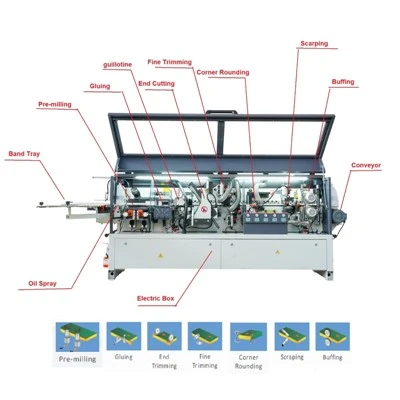
The sequence on the frame: gluing, end trimming, fine trimming, buffing. The end-trimming step is drawn with two cutters because the machine carries two heads, one for each end of the band.
Five defects, and where to look first
Short-part defects
What to check before adjusting anything
| Step at one end of the band | Head reference or a panel that entered out of square. Check the entry ruler before touching the cutter. |
| Chipped tape at a corner | Trim cutting before the adhesive has set - usually a cold pot or a feed that is too fast for the glue. |
| Glue squeeze-out on the face | Too much adhesive at the pot, or a glue temperature below the working range. |
| Tape lifting at the trailing end | End trim set too far back, or an insert that has done its work and is tearing rather than cutting. |
| Width creeping over a batch | The fence, not the cutter. Measure the same panel twice an hour before adjusting a head. |
Entry ruler and easy-run block: a panel that enters square is half the trim.

Tape and inserts on short parts
A drawer side usually wants the thinnest band the job will accept, because the band is read as a line rather than as an edge. A door wants the thickest the design allows. On this machine the range runs from 0.4 to 2 mm, and the same trim head has to cut both - which is why the head is set from a test part rather than from a table.
Colour is decided on the board, not on a swatch. PVC, ABS, veneer, melamine and acrylic all read differently against a printed finish, and the difference shows up worst on the narrow face of a drawer side where there is no field to distract the eye.
Inserts are the other consumable that decides the end. They cut cleanly for a long time and then stop cutting and start tearing, and the change is not gradual enough to notice on a running line. Keep a spare set, and look at the ends of the first part after every long batch rather than listening to the machine.

Fine trimming and air preparation, the two settings a thickness change touches.
Before the order: what to test, what to ask
Ask for a sample of the shortest part in your list, not the widest. Watch both ends of that part, and ask the operator to set a trim on one head while you watch - on this build that is a two-minute demonstration, and on a single-motor machine it turns into a conversation about adjustment.
Then ask three dull questions of any automatic panel edge bander supplier. Which inserts are in the trim heads and where are they bought; what the spare set costs; and whether the glue pot is the easy-change type. None of them appears on a quotation, and all three decide what year two of ownership feels like.
Finally, take the packing list seriously. Cutters and wearing parts travel in a separate case, and a machine that arrives with the trim heads still mounted has been packed by someone in a hurry.
CE and machine-safety certificates ship with the machine, ready to forward.

Specification of the standard build
TT-306DBT technical data
380 V / 50 Hz three-phase, 0.5 MPa air
| Model | TT-306DBT |
| Smallest part, length | 80 mm |
| Smallest part, width | 50 mm |
| Panel thickness | 10 - 45 mm |
| Tape thickness | 0.4 - 2 mm |
| Feed | 8 m/min |
| Installed power | 4.75 kW |
| Machine size | 2,190 x 585 x 1,410 mm |
| Net weight | 580 kg |
| End trimming | Two heads, one motor each, direct drive |
What this build is not
It does not pre-mill and it does not round tape corners; the pre-milling version is described on the straight edge banding machine page. What it does is take the short parts a single-motor trimmer refuses - a different purchase from a machine that prepares a rough board edge.
Shaped work belongs on another machine entirely; the edge banding machine types guide sets out how straight, curved and double-sided work divide before a model is chosen.
Packing and delivery

Crated for sea freight: plywood case, bubble wrap and stretch film over the painted surfaces, cutters and wearing parts in a separate case with a packing list.
Questions from cabinet shops
FAQ
Q: What does the T buy over the TT-306DB?
A: Each trim head gets its own drive instead of sharing one. That is the whole difference, and it is what puts 80 x 50 mm inside the working range.
Q: Will it run an 80 mm drawer side?
A: 80 mm long by 50 mm wide is the floor, on 10 to 45 mm panels. Under that the pressure beam cannot hold enough of the part, and hand banding is the honest answer.
Q: Is pre-milling available?
A: Not on this build, and not on any 306 with two trim motors instead. Rough board edges call for the pre-milling machine; rounded tape corners call for the DSA.
Q: How long is a changeover?
A: The trim heads take the time, and each is set at its own head. Tape, thickness and glue are minutes. Run a first-off part after every change.
Q: What does it need on site?
A: Three-phase 380 V at 50 Hz and 0.5 MPa air, 4.75 kW installed. Other supplies are built to order.
Send the smallest part you band
Length, width, thickness and the tape you run. If the shortest part clears 80 x 50 mm this automatic panel edge bander will run it; if it does not, we will say so rather than sell you the wrong build.