EDGE BANDING KNOWLEDGE BASE
Edge banding is the last operation before a panel leaves the factory and the first thing a customer touches. This guide explains how an edge banding machine works, which stations actually change the result, how tape and glue choices interact, and how to size a machine to the panels you really run.
ONE PASS, SEVEN STATIONS
01
Pre-milling
Squares the edge before glue
02
Gluing
Applies hot-melt adhesive
03
End trimming
Cuts the tape at both ends
04
Fine trimming
Trims flush top and bottom
05
Corner rounding
Softens the tape corners
06
Scraping
Removes surface marks
07
Buffing
Polishes to a uniform sheen
What is edge banding and why it matters
Edge banding is the process of applying a strip of material to the exposed edges of a manufactured panel - MDF, particle board, plywood - after it has been cut to size. The strip is bonded with hot-melt adhesive and then trimmed flush, so the finished edge looks solid rather than showing the chipboard core.
It is a small step with four large consequences:
Moisture
A sealed edge stops the core absorbing humidity, which is what causes swelling and telegraphing through the surface.
Impact
The edge takes the knocks. Banded edges resist chipping and delamination far better than a bare core.
Appearance
Edge tape sets the visible line of a cabinet. Colour match and a tight glue line are what buyers judge.
Handling
A finished edge protects the panel through packing, transport and installation.
Why the edge is the quality signal
Anyone can look at a panel face. The edge is where a buyer checks whether the factory is serious - the seam, the corner, the trim. That is why edge banding machines get more attention than any other station in a panel shop.
The edge banding process, station by station
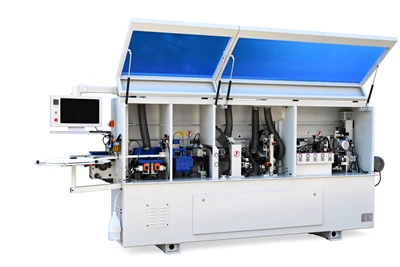
An automatic edge banding machine runs these stations in one continuous pass. The panel is clamped once at the infeed and does not stop between them, which is exactly why the order and the condition of each station matter.
STATION 01
Pre-milling
Two cutter heads square and clean the panel edge before any adhesive is applied.
If it is missing: Skip it and the tape bridges the saw marks instead of sitting on a flat surface; the seam opens within months.
STATION 02
Gluing
A heated glue pot applies a controlled bead of hot-melt adhesive to the edge and to the tape.
If it is missing: Too little glue leaves a visible line; too much squeezes out and gums up the trim stations.
STATION 03
End trimming
Two heads cut the tape at the leading and trailing ends of the panel.
If it is missing: A single-motor unit struggles with short or narrow parts; the ends end up over- or under-trimmed.
STATION 04
Fine trimming
Flush-trims the tape above and below the panel face.
If it is missing: This is where a chipped or wavy edge appears if cutters are dull or the pressure beam is loose.
STATION 05
Corner rounding
Rounds the two tape corners at each end of the edge.
If it is missing: Without it the corner stays sharp, catches on cloth and chips first in handling.
STATION 06
Scraping
Removes the fine cutter marks and the glue film from the tape surface.
If it is missing: Leaves the matte machining pattern visible on what should be a smooth edge.
STATION 07
Buffing
Polishes the edge to a uniform sheen and blends the tape into the panel.
If it is missing: The edge reads dull against a gloss panel, and the difference shows up under showroom lighting.
Types of edge banding machine
Five practical categories cover most of the market, and they differ mainly in which stations are automated: portable, semi-automatic, automatic entry, automatic with pre-milling, and automatic with pre-milling plus corner rounding.
Station count is only one axis. Geometry, single or double-sided working, glue type and batch size change the answer more often. We compared those four axes separately in our edge banding machine types guide, including a table that maps a panel mix to a machine type.
A practical rule: if your panels are cut on a panel saw and the edge shows a visible saw mark, you need pre-milling. If you produce drawer fronts, door rails or any part under 300 mm, you need independent dual-motor end trimming.
Edge banding tape: matching material to panel
Tape choice for an edge banding machine is usually settled by the panel face and the price point, not by the machine. What the machine controls is thickness capability and how cleanly the tape is trimmed.
Tape
Where it is used
What to know
PVC
The default for cabinet and office furniture
Wide colour range, good impact resistance, easy to trim
ABS
Higher-end furniture and areas near heat
More heat-resistant than PVC, less brittle, higher cost
Acrylic
Gloss and high-gloss designs
Matches gloss panels; scratches show more, so buffing quality matters
Melamine
Budget carcass work and colour matching to board
Thin and brittle; needs sharp cutters and careful trimming
Veneer
Solid-wood and veneered furniture
Matches real wood; grain direction and sanding after trimming
Thickness limits on the TingTing range
The TT-306 platform runs 0.4–2 mm tape; the TT-308 platform runs 0.3–2 mm. 3 mm tape needs custom cutters, so confirm the tooling at order stage rather than after delivery.
Glue systems explained: EVA and PUR
Every automatic edge banding machine in this class applies hot-melt adhesive from a heated pot. The two adhesives you will be offered behave very differently after the panel leaves the factory.
Adhesive
How it works
Where it fits
EVA hot melt
Applied molten and sets as it cools. Reversible with heat, so the joint can be re-opened.
Interior furniture in dry conditions - the standard choice for cabinets, wardrobes and office furniture.
PUR reactive
Cures by reacting with ambient moisture, forming a chemical bond rather than a cooled one.
Kitchens, bathrooms, shopfitting and anywhere the edge meets steam or standing water.
Two practical points decide most of this. First, a pre-heat function matters: in an unheated workshop in winter the panel edge pulls heat out of the glue line before the tape lands, and the bond fails at the ends. Second, the glue pot itself should come out for cleaning without dismantling the station - a spiral pot keeps adhesive circulating evenly and is the difference between a five-minute clean and a half-day one.
Six factors that actually decide edge quality
An edge bander is judged at the seam. Everything below exists to make that seam identical on panel one and panel four thousand.
01
Pre-milling before the glue
Two independent motors with PCD cutter heads square the edge before adhesive is applied. A square edge is what keeps the band sitting flush a year later; skip this station and every later station is compensating for it.
02
Dual-motor end trimming
When each trim head is driven independently with a direct-drive structure, there is no intermediate transmission in the setup chain. Short and narrow workpieces that a single-motor trimmer struggles with become routine.
03
Easy-change glue pot
The tank lifts out for cleaning without dismantling the station, and the spiral geometry keeps adhesive circulating evenly rather than scorching at the wall.
04
Control and repeatability
A touch screen that exposes every parameter, plus a panel counter that totals running length and working time, turns setup from an operator skill into a stored recipe.
05
Corner rounding, scraping, buffing
Corner rounding removes the sharp tape corner that catches on a cloth. Scraping clears the surface marks, then buffing brings the edge to a uniform sheen.
06
Automatic thickness adjustment
The press beam follows panel thickness up and down, and the conveyor stops if a board exceeds the preset thickness. Automatic standby cuts idle power between jobs.
How to choose an edge banding machine: five questions
Buyers usually start from price and end up buying twice. Work through these five questions instead - they narrow the range faster than any spec sheet.
Q1
What is your smallest part?
The minimum panel size, not the maximum, eliminates the most models.
Q2
What is the edge cut like?
A clean cut needs no pre-milling. A saw mark does.
Q3
How many panels a shift?
Feed speed matters less than changeover time on mixed batches.
Q4
How much floor do you have?
Machine bodies run from 1,750 mm to 3,880 mm.
Q5
Which edge will the customer see?
Visible edges justify corner rounding and buffing.
If this is your situation
The decisive feature
Look at
Panels under 300 mm, drawer fronts, door rails
Independent dual-motor end trimming; 80 × 50 mm minimum
TT-306DBT
MDF or melamine with a visible saw mark on the edge
Pre-milling with PCD cutter heads
TT-306DSP / TT-308DSP
Mixed batches with frequent changeover
Automatic thickness adjustment, stored recipes
TT-306DSA / TT-308DSA
Continuous shifts, output is the constraint
8 / 12 / 16 m/min feed, heavier base
TT-308DS / TT-308DSP
Visible edges on contract furniture
Corner rounding, scraping and buffing
TT-308DSR / TT-308DSA
Two of these five questions - smallest part and edge cut condition - decide the model more often than daily output does. Output can be bought with a second shift; a panel that will not fit through the machine cannot be fixed at all.
Common edge defects and what causes them
Almost every edge banding machine fault traces back to one of four things: a dull cutter, a cold glue line, a loose reference, or a station that was never installed. The table maps the symptom to the cause so an operator can diagnose it without calling service.
Symptom
Likely cause
First thing to check
Chipping along the edge
Dull cutters, feed too fast, or no pre-milling on a rough sawn edge
Replace or sharpen cutters, slow the feed, add pre-milling
Visible glue line
Glue temperature too low, insufficient bead, or panel edge not square
Check pot temperature and bead size, verify pre-milling
Tape trimmed short at the ends
End trim unit out of adjustment, or panel not held square
Re-set the end trim heads, check the reference fence
Wavy or rippled tape
Worn pressure rollers, feed speed too high for the tape
Replace rollers, reduce feed speed
Tape lifting at the corners
No corner rounding, or adhesive starved at the panel ends
Add corner rounding, check glue coverage at the ends
Scratches on the tape surface
Scraping blade set too deep, contaminated buffing wheel
Back off the scraper, clean or replace the wheel
If the same defect appears on the same side of every panel, suspect the reference or the pressure beam. If it is random across a batch, suspect cutters or glue temperature.
Maintenance checklist that protects edge quality
Most edge faults are maintenance faults wearing a disguise. Three routines keep an edge banding machine in adjustment, and all three are short enough to actually get done.
Every shift
·Drain and clean the glue pot while warm
·Wipe the pressure rollers and the reference fence
·Check the tape path for adhesive build-up
·Confirm the panel counter and standby function are working
Weekly
·Inspect cutter edges under light for chipping
·Check trim head adjustment against a test panel
·Clean the dust hoods and hoses - blocked extraction causes scratches
·Check air pressure at the machine, not at the compressor
Monthly
·Grease the linear guides per the manual
·Check belt and chain tension on the feed
·Verify the electrical cabinet for dust and loose terminals
·Run a scrap panel through every station and compare to the reference sample
Our range: TT-306 and TT-308 edge banding machines
Everything above is the theory. This is how it is applied in the machines we build - two platforms, twelve models, one station architecture.
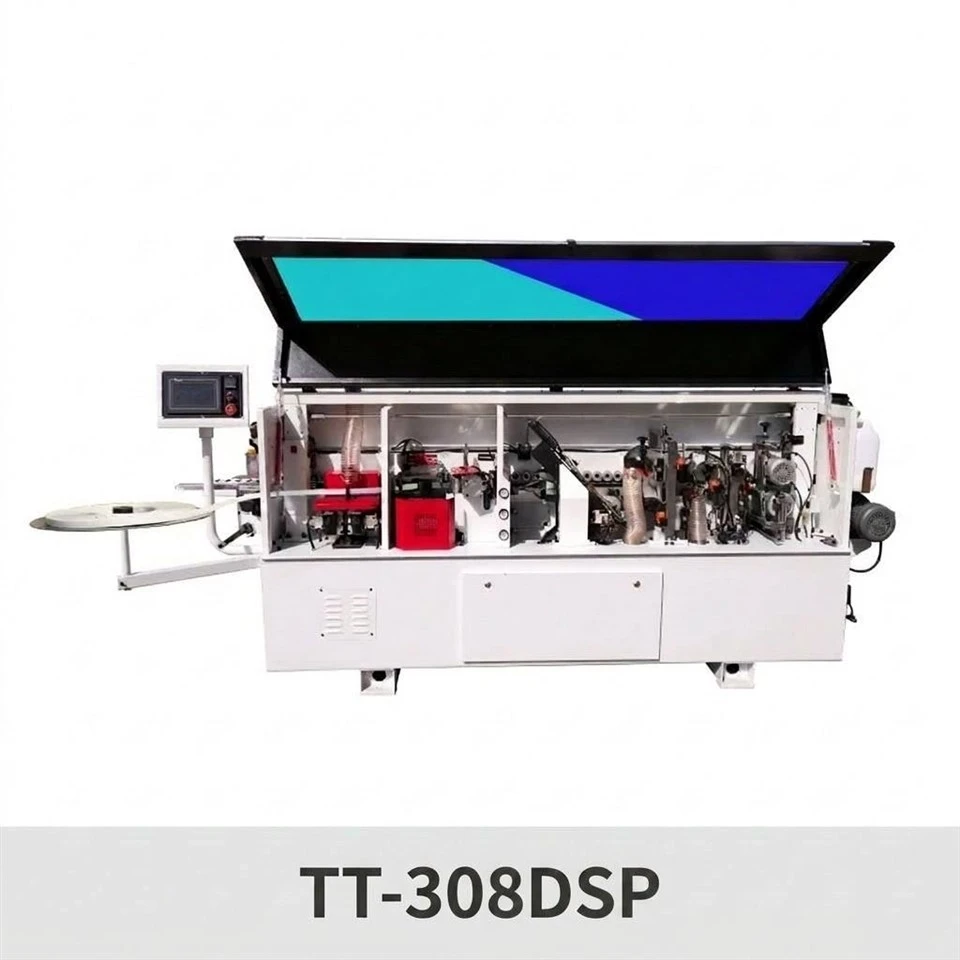

12
models across the two platforms, from a 1,750 mm compact body to a 3,880 mm production machine.
Compare all models →If you are unsure which platform fits, send your smallest and largest panel plus the edge tape you use - that narrows twelve models to two or three.
Frequently asked questions
What does an edge banding machine do?
An edge banding machine bonds a strip of PVC, ABS, acrylic, melamine or veneer tape to the cut edges of a manufactured panel, then trims it flush so the edge is sealed and looks like solid material. An automatic machine runs pre-milling, gluing, end trimming, fine trimming, scraping and buffing in one continuous pass.
Do I really need pre-milling?
If your panels come off a panel saw and the edge shows a visible saw mark, yes. Pre-milling squares the edge with two cutter heads before gluing, and that flat surface is what keeps the tape sitting flush over time. On a clean, freshly cut edge some buyers run without it and accept a shorter service life at the seam.
What is the difference between the TT-306 and TT-308 series?
The TT-306 is the compact platform: 1,750–3,220 mm bodies, 8 m/min, 4.0–6.8 kW, and a minimum panel of 80 × 50 mm on the DBT. The TT-308 is the faster platform: 3,100–3,880 mm bodies, 8 / 12 / 16 m/min, 5.5–8.15 kW, a heavier base, and corner rounding standard on the DS, DSR and DSA models.
What edge tape thickness can the machines handle?
The TT-306 platform runs 0.4–2 mm tape and the TT-308 platform runs 0.3–2 mm. Tape at 3 mm needs custom cutters, which are specified at order stage.
Can it handle small panels?
That depends on the end trimming unit. The TT-306DBT uses independent dual-motor end trimming and takes panels down to 80 × 50 mm, which covers drawer fronts and door rails. Single-motor trimmers need a longer part to register against.
What maintenance does an edge banding machine need?
A shift-level routine (clean glue pot, wipe rollers, clear the tape path), a weekly check of cutter edges and trim adjustment, and monthly lubrication of the guides. Most edge defects are maintenance defects rather than machine faults.
What voltage do the machines ship with?
Standard build is 380 V / 50 Hz three-phase, with optional configurations for other supply standards. Voltage, frequency and control language are confirmed in writing before production.
How much does an edge banding machine cost?
It depends on the platform, the station mix and the tooling, so there is no single figure - a compact TT-306 with four stations and a TT-308 with corner rounding and pre-milling are different classes of machine. Send your panel sizes and the stations you need and we will quote against that.
Match a machine to your panel mix
Send your smallest and largest panel, panel thickness, edge tape type and daily output. We will come back with the two or three models that fit, and the stations each one needs.