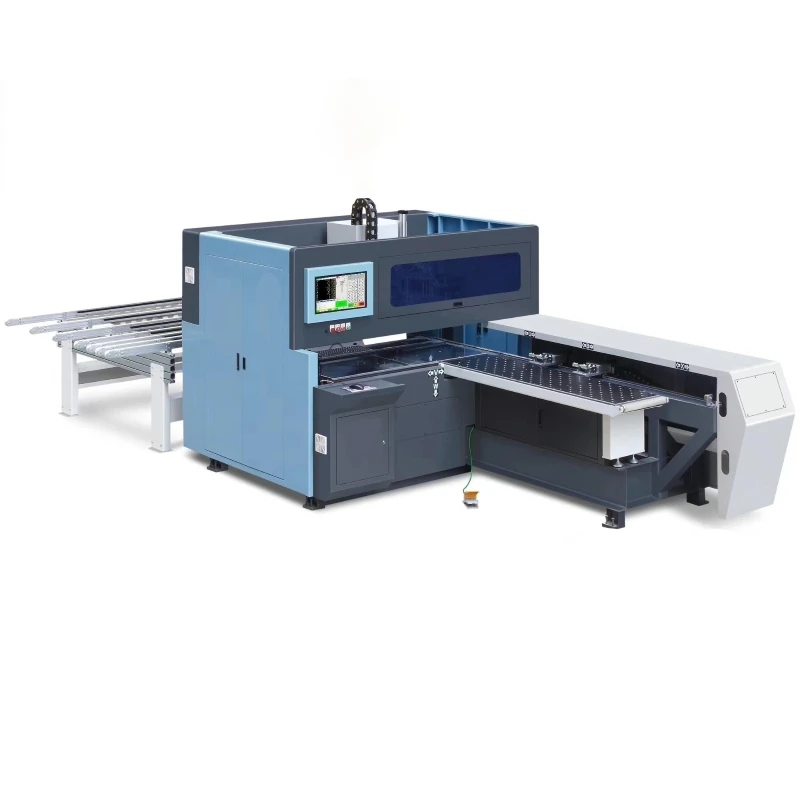
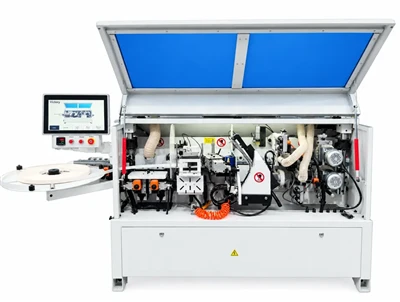
The working principle of a panel saw is based on digital control technology. After the operator inputs parameters such as the sheet material dimensions and cutting depth, the equipment automatically generates processing instructions and executes automated operations. Sheet material loading eliminates the need for manual individual placement; after being neatly stacked in the loading area, the automatic loading device picks up the sheet material and places it on the conveyor belt for cutting and punching.
The core structure of the panel saw aims to ensure high precision and stable operation. The table often employs an air-floating design, making sheet material movement easy and labor-saving, and preventing surface scratches. The drive and positioning system mostly uses servo-driven double lead screws to achieve high-precision positioning. The machine body uses an integral base, which undergoes stress-relief heat treatment, and is equipped with high-precision linear guides to ensure machine stability and smooth operation. The gantry structure is typically a thickened square steel gantry with high rigidity. In terms of the transmission system, the X/Y axes often use high-precision racks, and the Z-axis uses ball screws. Some machines are equipped with automatic tool changers (such as 12-row tool magazines) and vacuum adsorption tables to improve processing efficiency and adaptability.
To ensure operational safety, modern panel saws are equipped with multiple safety devices. For example, an infrared sensing safety zone is located near the cutting edge. When an object enters or approaches this zone, the infrared trigger switch disconnects, cutting off the power to the equipment and preventing accidents. In addition, the equipment typically includes a leakage current protection switch, an alarm system, and an emergency stop device.
The control system of the panel saw is the core of its automation and intelligence. Hardware-wise, it often uses a high-performance PC screen as the human-machine interface, offering simple operation (supporting Chinese/English). Software-wise, it employs programmed control, can store multiple sets of cutting parameters, and features file preprocessing and 3D curve prediction to ensure operational accuracy. Mainstream control system brands include Syntec, Pou Yuan, and Weihong from Taiwan. The drive system generally uses AC servo motors and drivers to achieve high-precision, high-response motion control.