Three things moved the woodworking machinery business this autumn, and none of them was a new machine. Trade shares shifted further toward Chinese supply, IWF published the audit of its 2026 edition, and the EU deforestation regulation acquired a date that has stopped moving. Read together, they describe a market that is buying less, checking more, and asking suppliers to prove things they were not asked to prove in 2023.

Trade, exhibitions and one regulation date, in four numbers
Four figures to carry into 2027 buying decisions: where supply now sits, how much trade there is to fight over, whether buyers are still travelling, and when the deforestation rules actually bite.
China export share
EUR m global trade
IWF registrations
Dec 2026 EUDR start
China is now the largest supplier, and the price map shows how
ExportPlanning's May 2026 analysis of 2025 trade puts the global woodworking machinery market at EUR 9,528 million. China supplied EUR 2,486 million of it, or 24.3 per cent - ahead of Germany at EUR 2,262 million (22.1 per cent) and Italy at EUR 1,374 million (13.4 per cent).
The ten-year line is starker than the snapshot. China's share went from 16.9 per cent in 2015 to 24.3 per cent in 2025, while the EU's fell from 57.0 to 53.4 per cent. The same analysis finds that low and lower-mid price bands grew from 75.7 to 91.5 per cent of Chinese exports - volume was won, the price band was not lifted.
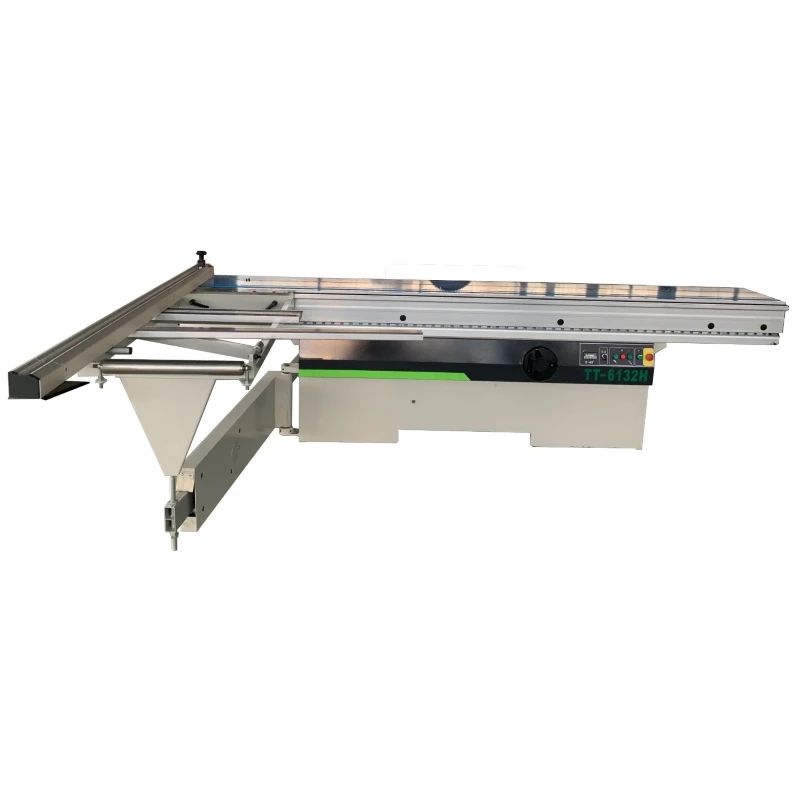
By product segment the picture splits. In sawing machines (HS 846591), a EUR 1,882 million trade segment, China holds 27.2 per cent against Germany's 15.1 and Italy's 6.9. In machining centres China still holds 7.4 per cent against Italy's 38.5 and Germany's 31.4. A Chinese machine competing where the buyer already runs a European reference is competing on documentation and service, not on the quote alone.
2025 woodworking machinery trade
ExportPlanning elaborations, published May 2026
| Global trade | EUR 9,528 million |
| China | EUR 2,486 m - 24.3% (16.9% in 2015) |
| Germany | EUR 2,262 m - 22.1% |
| Italy | EUR 1,374 m - 13.4% |
| EU share | 57.0% in 2015, 53.4% in 2025 |
| China: low and lower-mid price bands | 75.7% in 2015, 91.5% in 2025 |
Volume is the easy half of that story. The other half is what a buyer in a mature market asks for before signing: a test on their own part list, a spare-parts list that matches the cabinet, and documentation that survives being forwarded to their customer.

IWF 2026: 24,826 registrations, and a second show in Texas
The International Woodworking Fair released its 2026 performance audit on 4 November. The Atlanta edition, held 25-28 August at the Georgia World Congress Center, recorded 24,826 registrations including 17,058 buyers, with 989 exhibiting companies across 668,912 net square feet and 201 first-time exhibitors.
The audience was unusually new: 46 per cent of registered buyers were attending IWF for the first time, and they came from all 50 US states and 84 countries. Post-show research by MMR Research Associates found 92 per cent of attendees saying the show met or exceeded expectations, 87 per cent reporting a positive return, and 83 per cent making or directly influencing purchasing decisions. On the exhibitor side, 72 per cent reported well-qualified buyers and 79 per cent plan to return in 2028.
The calendar change matters more than the numbers for anyone planning a North American push: IWF West debuts on 25-27 August 2027 at the Henry B. Gonzalez Convention Center in San Antonio, Texas, with Atlanta returning in 2028. That gives exporters a second door into the US market in an off year - and a decision about whether to exhibit twice, once, or not at all.
The EUDR clock: 30 December 2026
Regulation (EU) 2023/1115, the deforestation regulation, applies from 30 December 2026 for large and medium-sized operators, with micro and small enterprises given until 30 June 2027. It covers wood and a list of derived products, furniture and panels among them, and it asks operators placing those goods on the EU market to show the material is deforestation-free and legally produced, with geolocation behind the claim.
A machine supplier does not file a due diligence statement. The customer does. That is exactly why the question reaches the machine: if a panel or furniture maker has to document board origin and keep batch records, then the equipment in that factory has to produce a consistent, traceable result on board it did not choose. Consistency at the edge and repeatability across a batch stop being selling points and become part of the compliance trail.
A contraction, and what buyers do inside one
The same ExportPlanning work records global demand down 10.7 per cent year on year in euros in the first quarter of 2026, with Italian exports down 8.8 per cent, and forecasts average growth of about 1 per cent a year through 2029. Fewer machines are being bought, and the ones that are get evaluated longer.
In that market, three arguments win and one stops working. Payback on a specific part list wins. Changeover time on small batches wins. Spare parts a local technician can fit wins. Catalogue top speed, on its own, no longer does.
Dates worth putting in the calendar
The next eighteen months
Regulatory and exhibition dates as published
| 30 December 2026 | EUDR applies to large and medium operators |
| 10-14 May 2027 | LIGNA, Hannover - the next edition of the world's leading woodworking fair |
| 30 June 2027 | EUDR applies to micro and small enterprises |
| 25-27 August 2027 | IWF West, San Antonio, Texas - first edition |
| 2028 | IWF Atlanta returns |
Where this leaves a panel shop
Three practical consequences, in the order they usually hit a workshop. First, test a machine on your own part list rather than a demonstration panel - the smallest part and the worst board you actually buy decide more than the widest one. Second, ask for the documents you will have to forward: spare-parts list, cutter specification, and a packing list that matches what arrives. Third, plan the changeover, not the top speed; a machine that takes ten minutes to reset is a machine that runs small batches.

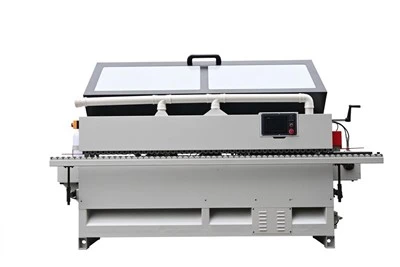
The sequence a buyer should be able to watch run on their own board: gluing, end trimming, fine trimming, buffing - in that order, without the panel being lifted between stations.
For cabinet work in the 306 range, that argument is why the dual-motor end trimming build exists - it takes parts down to 80 x 50 mm, which is where a drawer programme actually lives. The pre-milling build covers the opposite case, board that arrives from the saw with tear-out. Which of the two is right depends on the part list, not on the price list.
- ExportPlanning, The global trade of woodworking machinery: Italy's position between quality excellence and global challenges, 14 May 2026
- Surface & Panel, IWF 2026 Draws Nearly 25,000 Registrants, Reports Strong Exhibitor and Buyer Satisfaction, 4 November 2026
- EUDR FAQ, Regulation (EU) 2023/1115 application dates, October 2026
- Deutsche Messe, LIGNA 2027 dates announced for 10-14 May 2027, Hanover
Send the part list, not the budget
Smallest part, worst board, batch size and the tape you run. We will tell you which build answers it - and say so plainly if the answer is a machine we do not make.