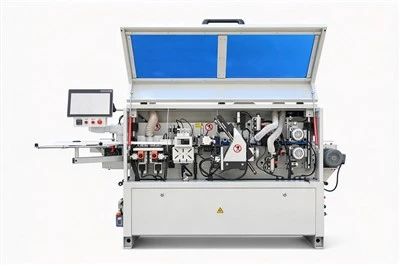
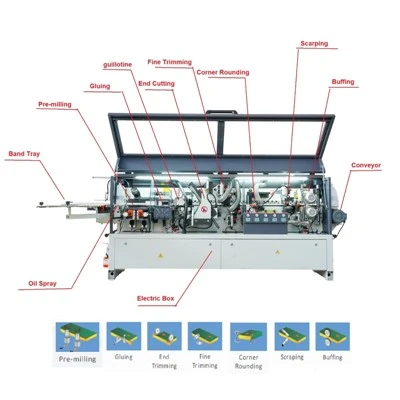
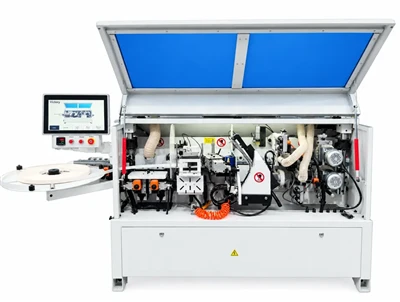
Pre-milling: Using double milling cutters, ripples, burrs, or non-perpendicularity caused by panel sawing/cutting are further refined to achieve a better edge banding effect. This results in a tighter fit between the edge banding strip and the board, improving overall integrity and aesthetics.
Glue Application: A special structure ensures even glue application on both sides of the edge banding material and the board, guaranteeing a stronger adhesion.
End Trimming: Precision linear guide movement, automatic template tracking, and a high-frequency, high-speed motor ensure a smooth and flat cut surface.
Fine Trimming: Utilizing automatic template tracking and a high-frequency, high-speed motor structure, the trimmed edges are smooth and flat. This is used to remove excess edge banding material from the top and bottom of the edge banding strip. The fine trimming cutter is an R-shaped cutter. Primarily used for PVC and acrylic edge banding strips in panel furniture, preferably with edge banding strips thicker than 0.8mm.
Edge Scraping: Used to eliminate ripples caused by the non-linear cutting process during edge trimming, resulting in a smoother and cleaner finish on the top and bottom of the board.
Polishing: Clean the processed boards with a cotton polishing wheel to make the edge banding smoother.
Grooving: Used for directly grooving wardrobe side panels, bottom panels, etc., reducing the need for a panel saw and making it more convenient and faster; it can also be used for grooving aluminum edging on door panels.